

The Analogy: The Club Security Guard
Imagine your sensitive IC (the chip) is a VIP celebrity inside a club.
-
The Normal Guest (Normal Voltage): People with tickets (the correct voltage, like 5V) are allowed to walk past the guard and enter the club normally to see the VIP. The guard just stands there and doesn't interfere.
-
The Gate Crasher (The Voltage Spike): Suddenly, a giant angry mob (a static shock or a power surge) tries to rush the door. If they get inside, they will crush the VIP celebrity.
-
The Guard’s Reaction (The TVS Diode): The second the pressure at the door gets too high, the Security Guard stops being "passive." He grabs the entire mob and tackles them through a side exit that leads straight to the alleyway (Ground).
-
The Result: The VIP celebrity inside the club never even knew there was a riot at the door. They stayed safe and kept working. Once the mob is gone, the guard stands back up and waits for the next normal guest.
.png)
Where do Surges Come From?
Overvoltage conditions occur when supply voltage exceeds a device's absolute maximum rating. The primary culprits include:
-
Human Contact ESD: Walking across a carpet can generate thousands of volts. Touching a USB port in dry weather can discharge several kilovolts (kV) of energy.
-
Lightning Transients: While not for direct hits, TVS diodes protect against induced transients that travel through power lines for up to a mile.
-
Electrically-Fast Transients (EFT): Caused by switching inductive loads like heavy-duty motors or relays.
Introduction: The Silent Guardian in Your Circuit
Imagine you've just designed a beautiful PCB components carefully selected, traces routed perfectly, and the board looks like a work of art. You power it up, everything works great. Then one day, a voltage spike sneaks in maybe from a lightning strike nearby, maybe from an inductive load switching off and in a fraction of a millisecond, your hard work is fried.
This is where the TVS diode steps in.
A Transient Voltage Suppressor (TVS) diode is one of the most underrated yet critically important components in electronics design. It's compact, fast, reliable, and incredibly effective. If you're designing circuits that need to survive the real world, understanding TVS diodes isn't optional it's essential.
What Is a TVS Diode?
A TVS diode is a semiconductor protection device designed to clamp transient overvoltages and divert harmful surge currents away from sensitive components. It operates based on the avalanche breakdown principle when the voltage across it exceeds a defined threshold, the device rapidly conducts, shunting excess energy to ground.
Think of it as a pressure relief valve for your circuit. Under normal conditions, it sits quietly doing nothing. But the moment a dangerous spike appears, it reacts faster than almost any other protection component and absorbs the energy before it can cause damage.
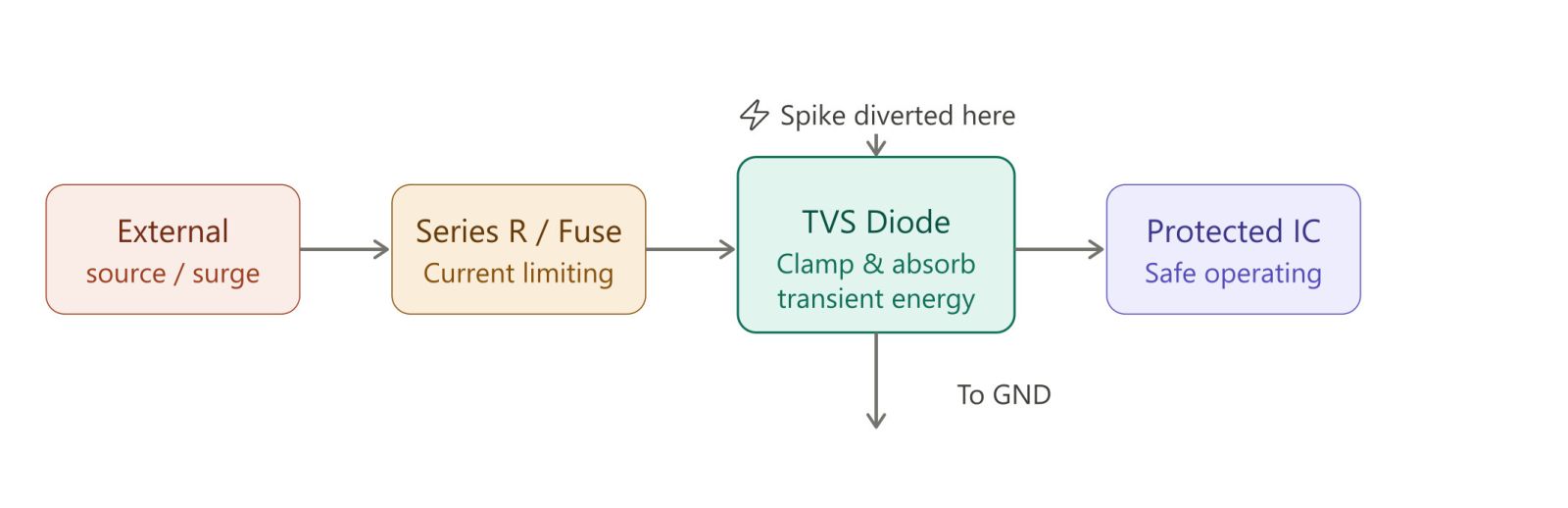
The surge enters from the left. A series resistor or fuse limits the current. The TVS diode sits across the line to ground the moment the voltage crosses its threshold, it clamps and shunts all the dangerous energy down to ground, letting only a clean, safe signal continue to your IC on the right. Click any block to explore further.
Classes of TVS Diodes
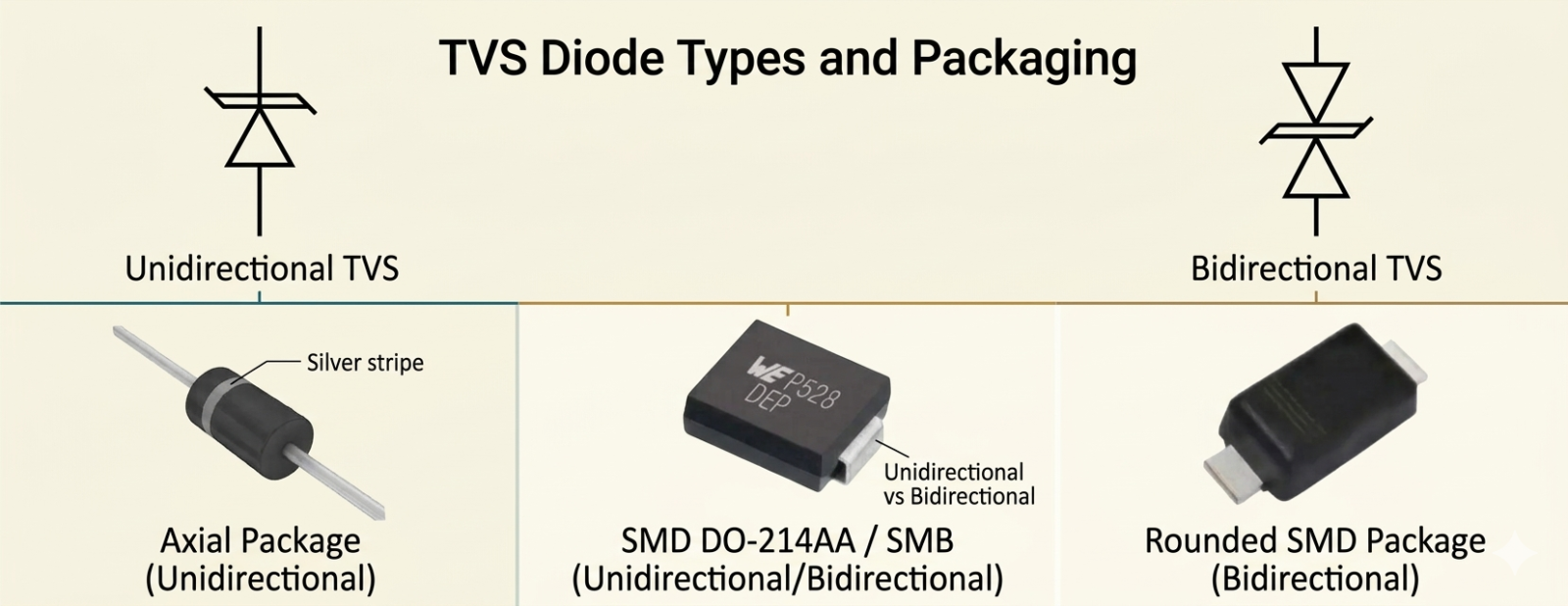
TVS diodes are broadly classified into two major categories based on their junction structure:
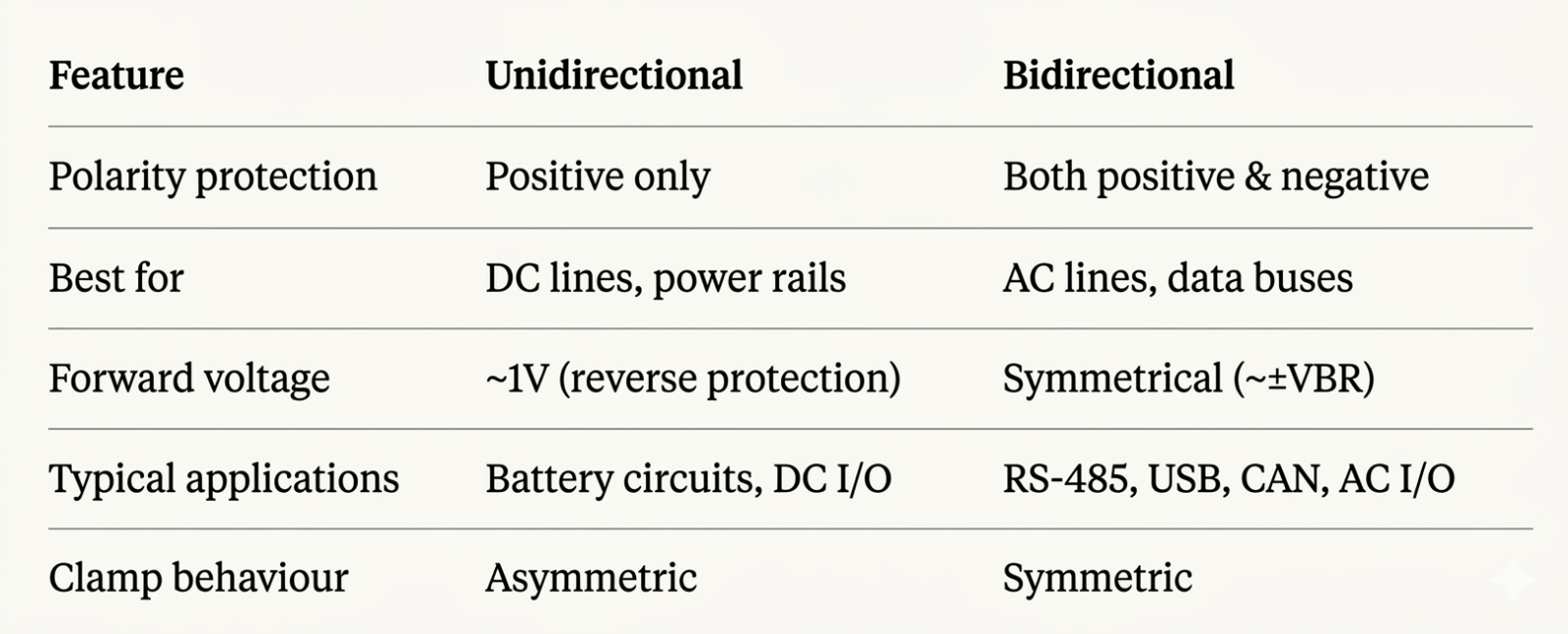
1. Unidirectional TVS Diodes
These are designed to protect against positive voltage transients only. They operate like a standard Zener diode in reverse — blocking voltage up to the breakdown point and then clamping sharply. They are ideal for DC circuits and single-polarity signal lines. Their forward voltage drop is typically around 1V, which also provides some protection in the reverse direction.
2. Bidirectional TVS Diodes
These protect against transients in both directions — positive and negative. They are symmetrical in their I-V characteristics and are the go-to choice for AC circuits, data lines, and communication interfaces where signals swing in both polarities. They are widely used in RS-485, CAN bus, and USB protection applications.
Beyond this fundamental split, TVS diodes also come in discrete single-channel devices for individual line protection, multi-channel arrays for protecting multiple data lines simultaneously, and rail clamp devices designed specifically for power supply rail protection.
TVS Diode Classification at a Glance
Protection Levels and Key Parameters
Understanding the protection level of a TVS diode requires familiarity with its core parameters. Here is a summary of every critical parameter you need to know before selecting a device:
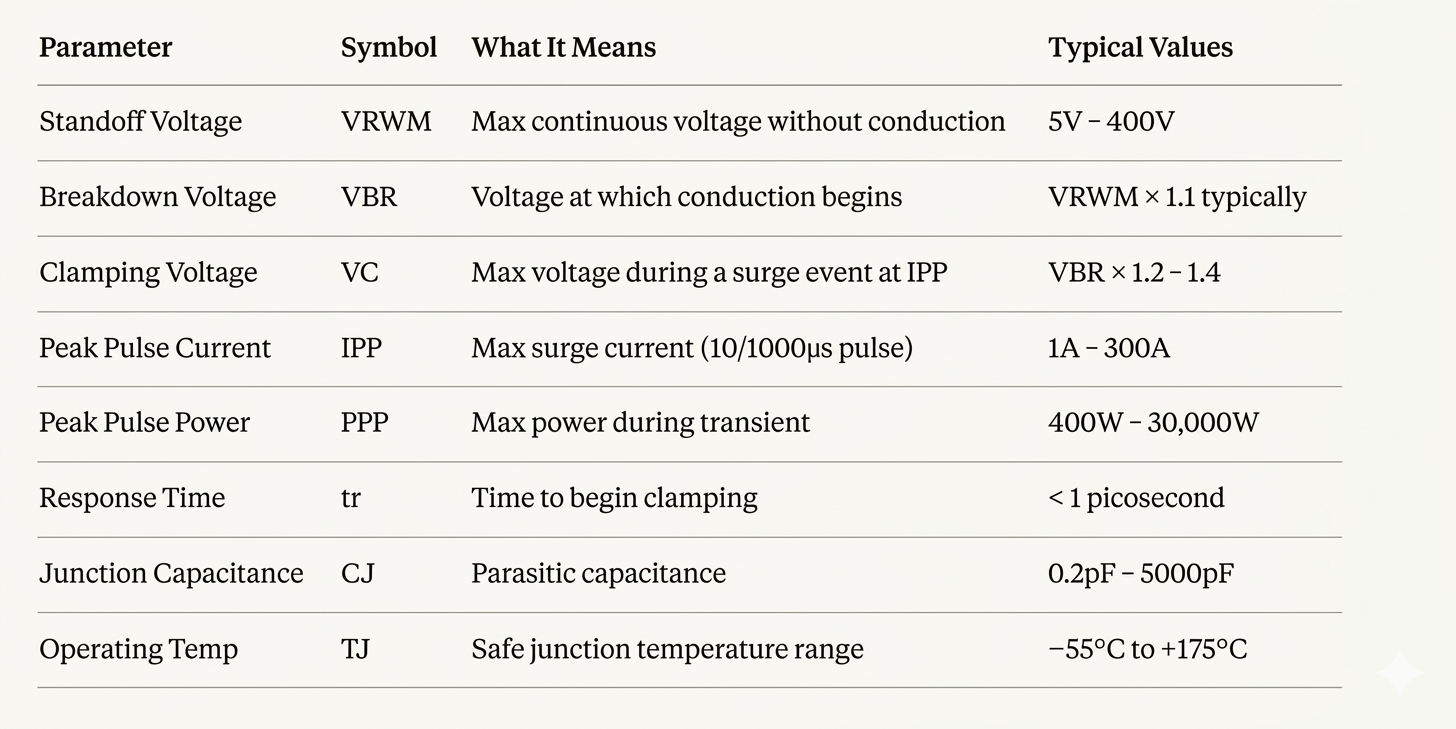
Standoff Voltage (VRWM):The maximum continuous voltage the TVS diode can withstand without conducting. Your operating voltage must stay below this value during normal operation.
Breakdown Voltage (VBR):The voltage at which the diode begins to conduct significantly typically 10% above the standoff voltage.
Clamping Voltage (VCL):This is perhaps the most critical parameter. It defines the maximum voltage across the TVS diode during a surge event at a specified peak pulse current. Your downstream components must tolerate this voltage.
Response Time:TVS diodes are extremely fast typically in the picosecond range. This makes them far superior to MOVs and gas discharge tubes in terms of response speed.
I-V Characteristic Curve:When designing circuits to withstand surges (like ESD or lightning), understanding how a TVS diode reacts to voltage is critical. These graphs show the relationship between Current (I) and Voltage (V).
.png)
1. Bidirectional TVS
A bidirectional TVS diode is designed to protect lines where the signal swings both positive and negative (like AC lines or RS-485 data buses).
-
Symmetry: Notice the graph is a mirror image across the origin. It handles transients in both directions.
-
Operation: It remains "invisible" (high impedance) until the voltage hits the breakdown point V_BR in either the positive or negative direction.
2. Unidirectional TVS
A unidirectional TVS diode is typically used for DC power rails or logic circuits where the voltage stays on one side of the zero line.
-
Asymmetry: In the positive direction (first quadrant), it acts as a protector, clamping high voltages.
-
Forward Bias: In the negative direction (third quadrant), it acts like a regular diode. It conducts immediately (the steep drop near the center), which can provide some "reverse polarity" protection but is not its primary job.
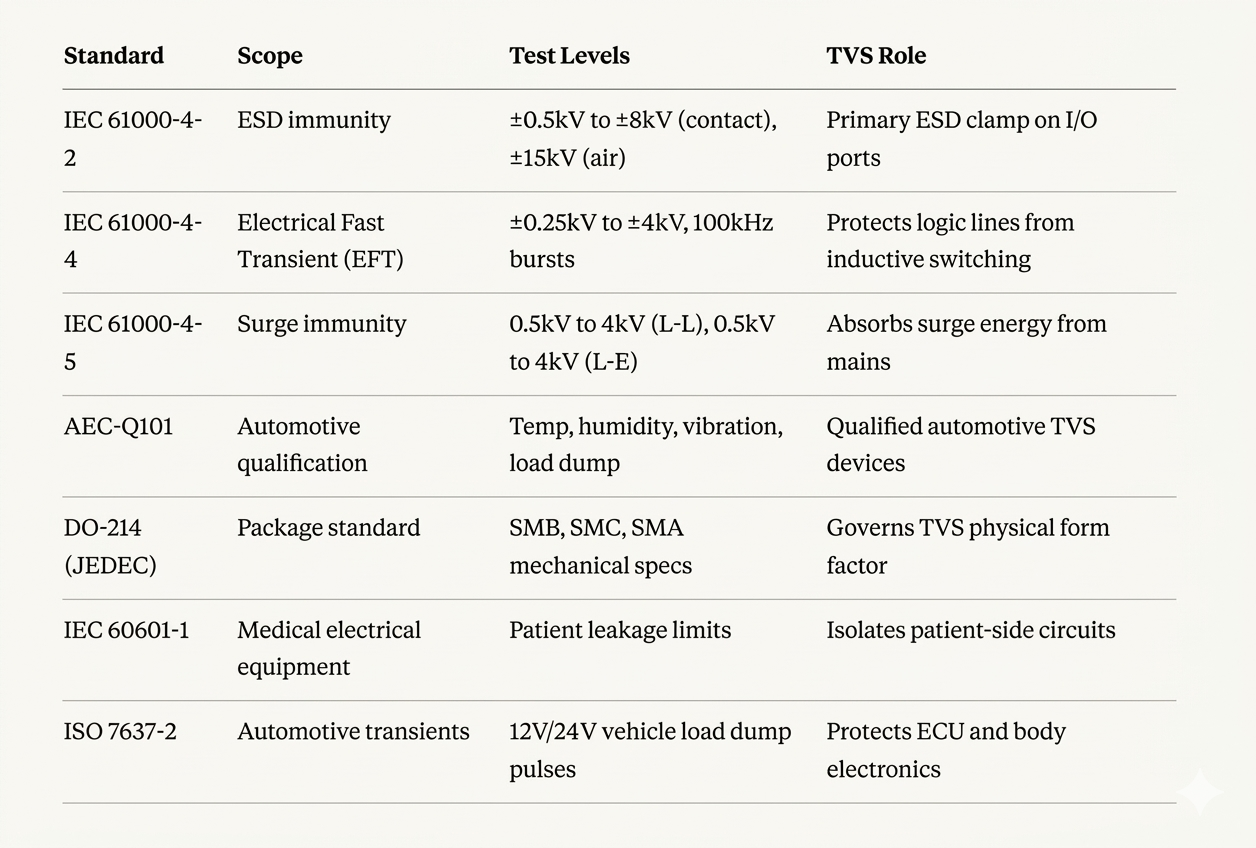
Standards and Compliance
For professional circuit design, TVS diodes must align with internationally recognized standards. This is not only good engineering practice , it is often a regulatory requirement.
Application Areas:
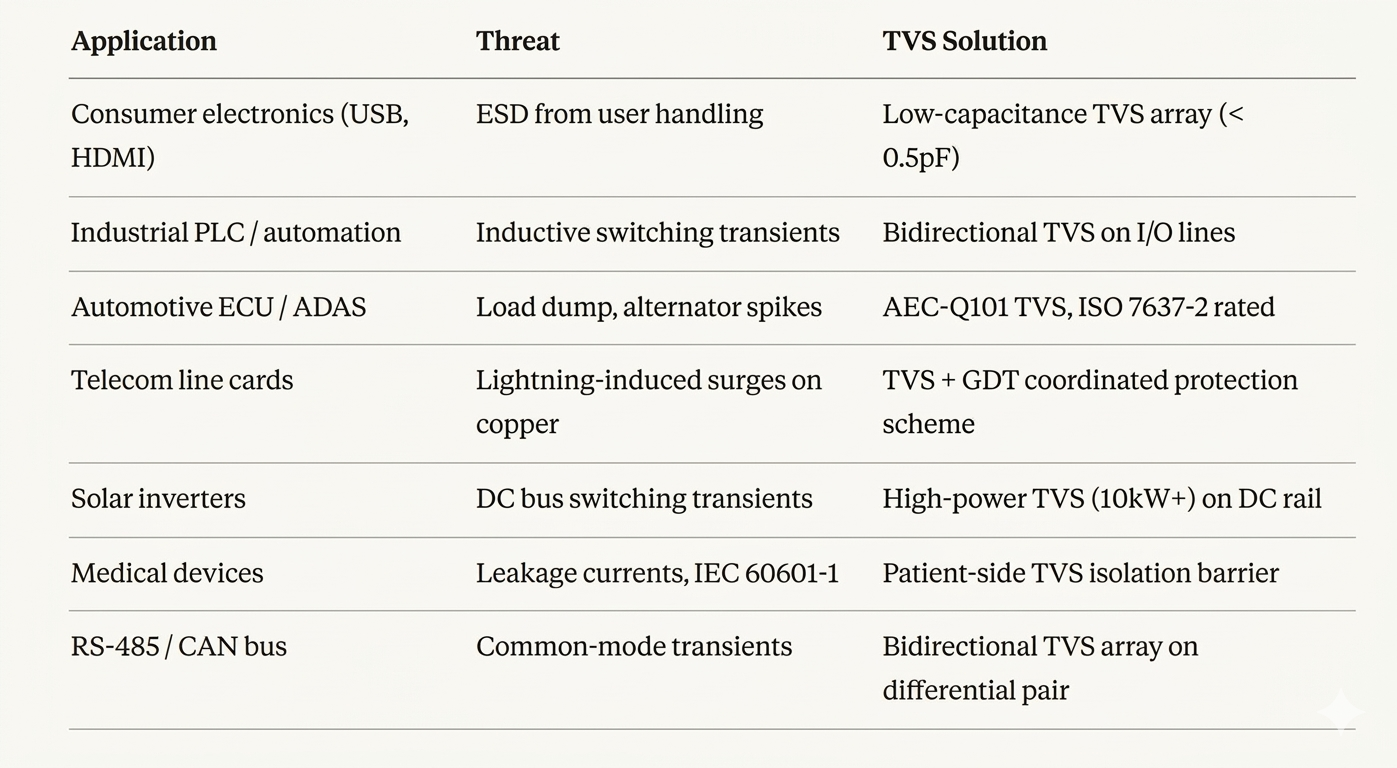
TVS diodes aren't just for one industry — they're deployed across a massive range of applications:
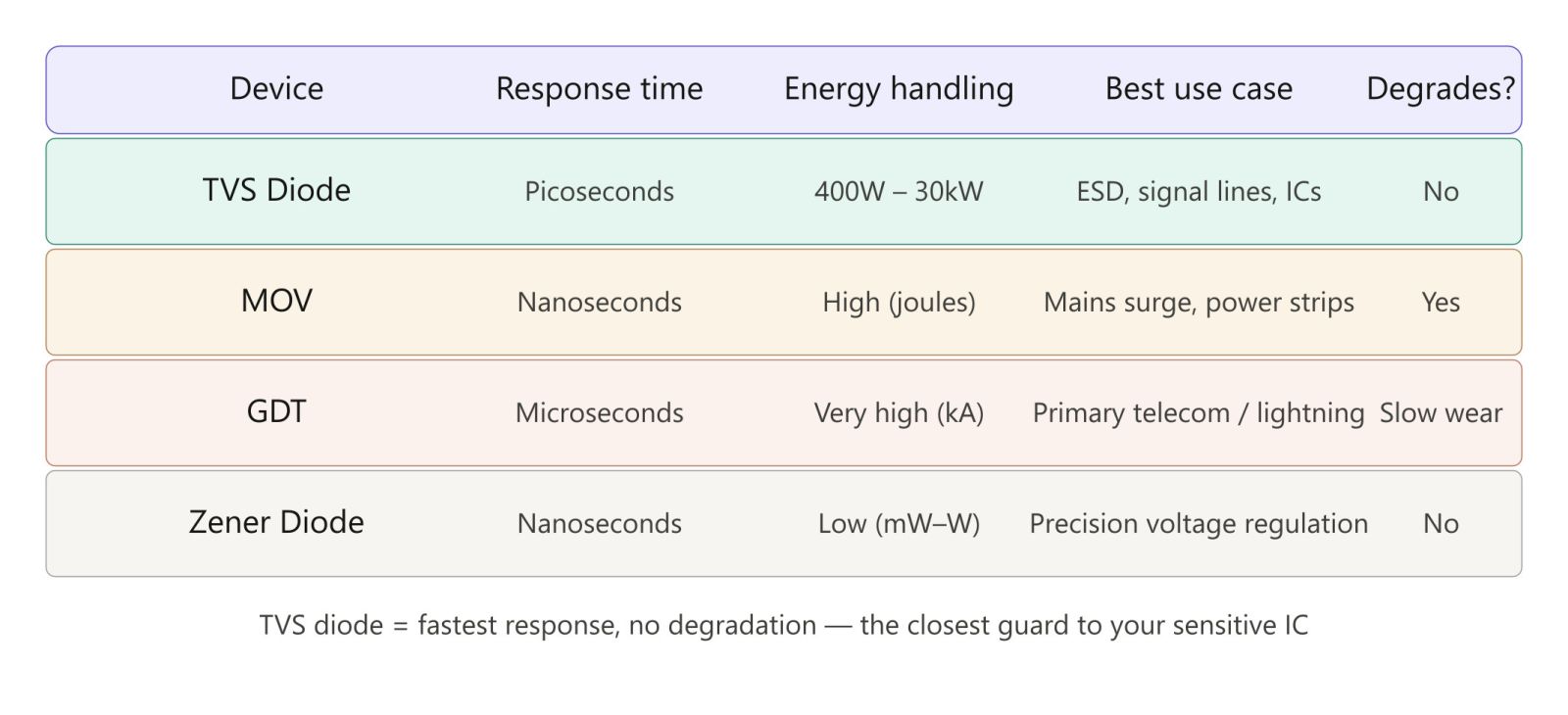
How TVS Diodes Stack Up Against Other Protection Devices The best strategy is layered protection.
In high-reliability designs, professionals combine all three: a GDT for primary surge clamping, an MOV for intermediate energy absorption, and a TVS diode as the final, fastest layer of protection closest to the sensitive IC.
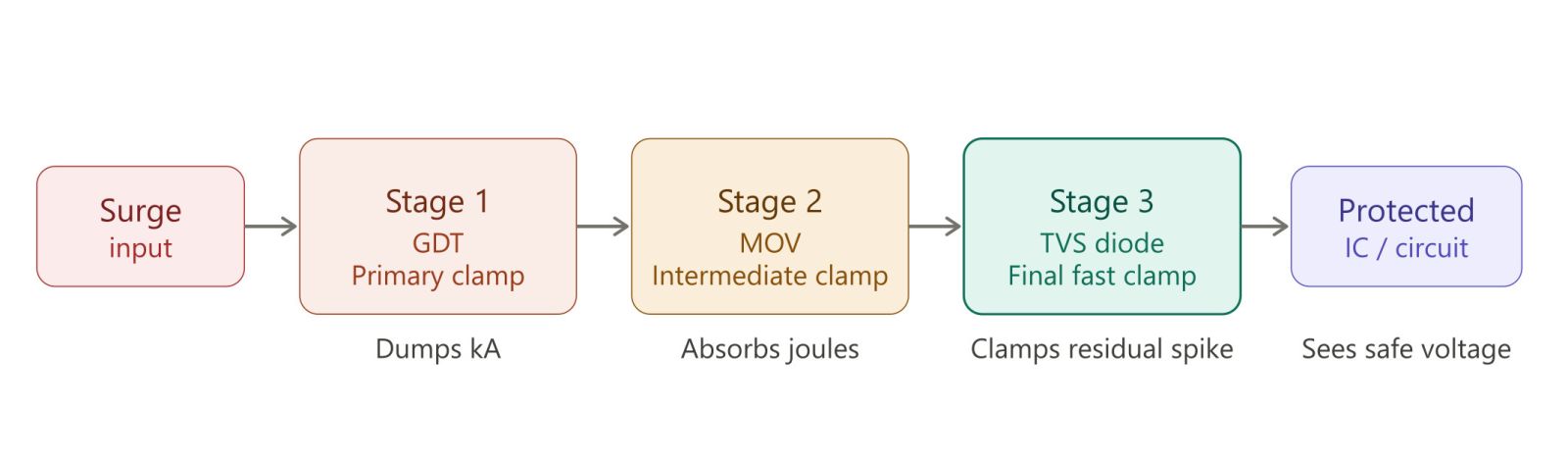
Layered Protection Architecture: The Professional Approach> Each stage handles what the previous one couldn't. The GDT takes the first brutal hit, the MOV absorbs the bulk of the residual energy, and the TVS diode — lightning-fast and precise — intercepts whatever is left and keeps the IC completely safe. Click any stage to learn more.
The Math of Protection
Let’s look at the power the TVS diode must dissipate. The power is the product of the clamping voltage and the peak pulse current:
PPP= VC x IPP
If an ESD event delivers a peak current I_PP of 30A and your TVS diode clamps that at 12V, the diode is momentarily handling:
12V \times 30A = 360W RDYN
Calculation Example:
If your IC can only survive 15V, and a 1000V spike hits the line:
-
The TVS breaks down at 6V.
-
It clamps the line at 12V.
-
The remaining 988V is dropped across the trace resistance and the source impedance of the surge.
Result: IC stays at 12V and survives!
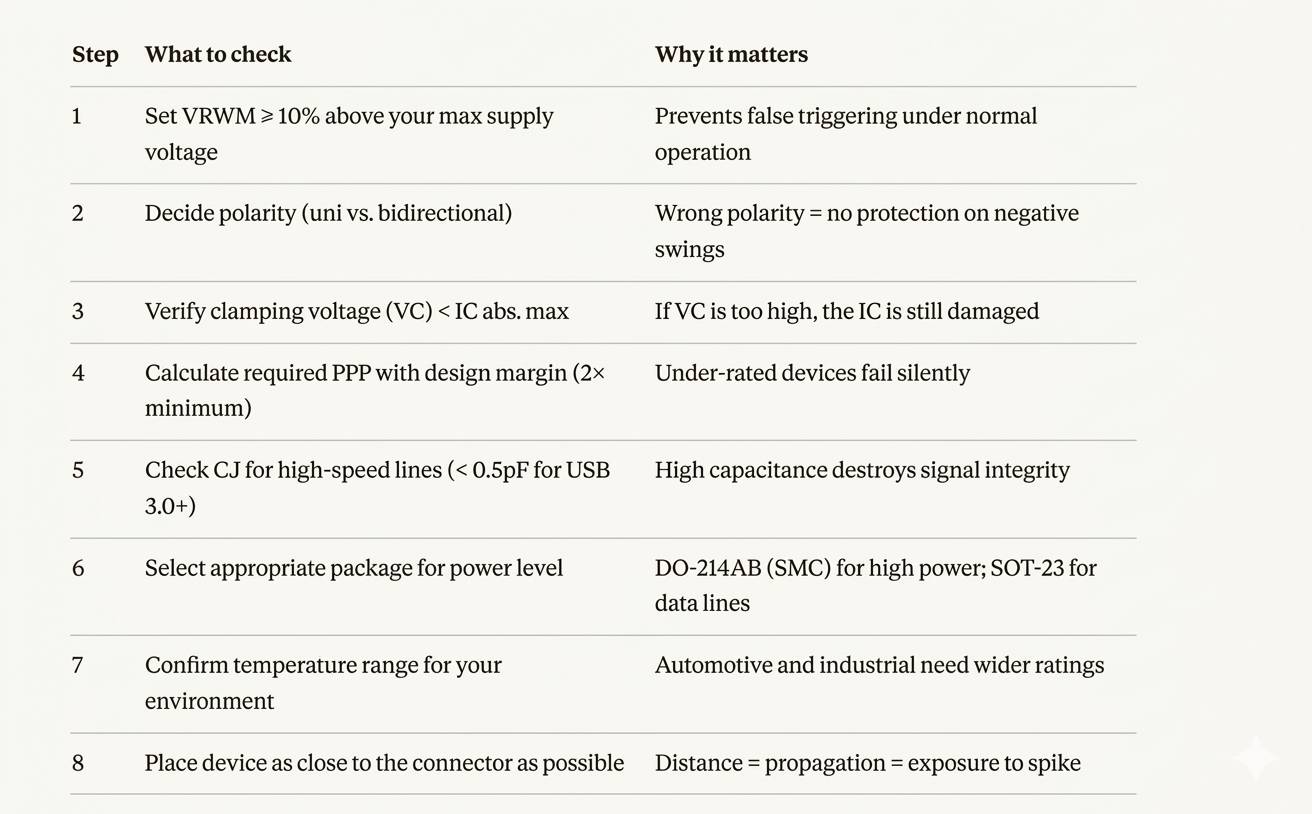
Selecting the Right TVS Diode: A Practical Checklist
When choosing a TVS diode for your design, work through this checklist:
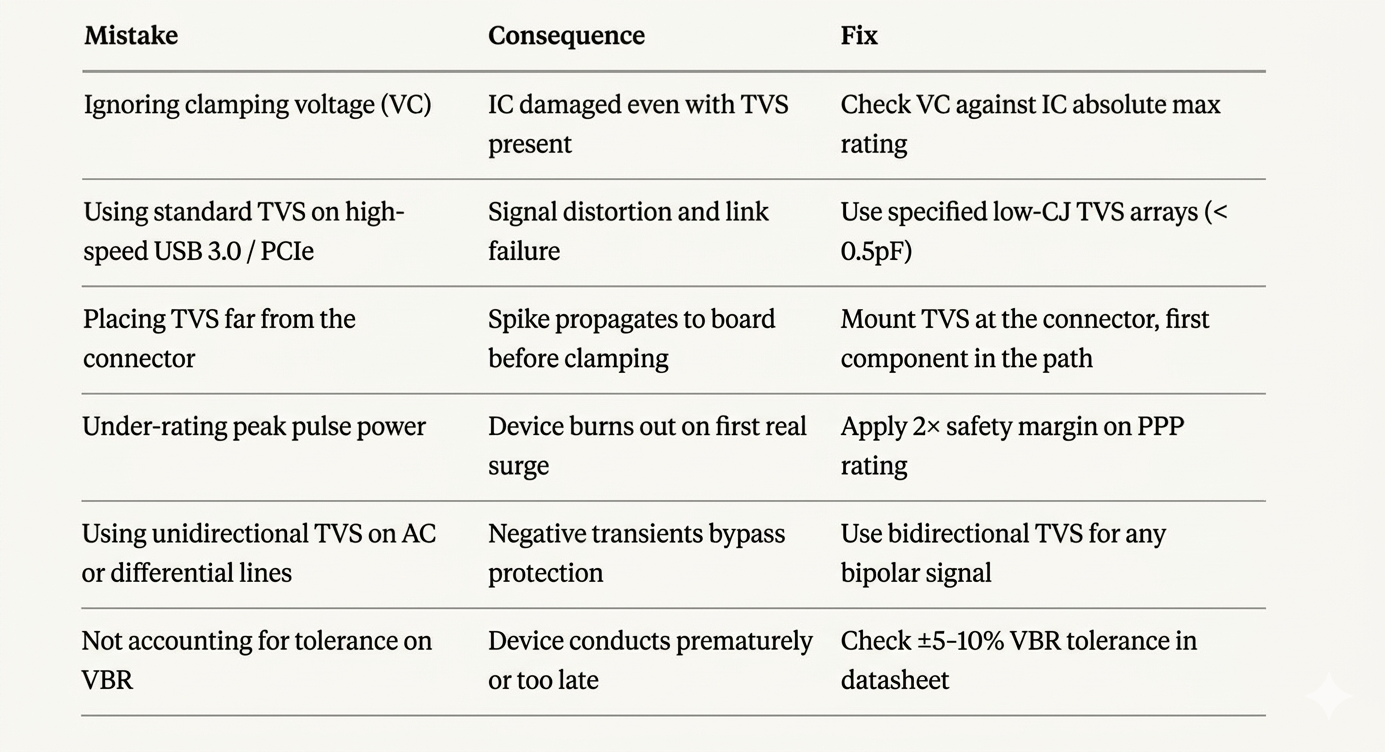
Common Mistakes Engineers Make:
Even experienced designers sometimes get this wrong. Here are the most costly pitfalls:
Conclusion: Don't Leave Your Circuit Defenceless