Last updated: 2026
If you are an electronics engineer, an electrical engineer student, or a parent paying for an engineering degree, you have asked this question. And you have probably read 20 blog posts that all say the same thing: "Don't worry, AI will not replace you. Just upskill."
That answer is half-true and half-lazy.
The real answer is more uncomfortable. Some electronics engineers will be replaced. Some will earn 20% more than they do today. The difference between the two groups has nothing to do with how smart they are, and everything to do with what kind of work they actually do.
This article cuts through the hype. It uses real numbers from the U.S. Bureau of Labor Statistics, IEEE Spectrum, the World Economic Forum, and current 2026 industry reports. No buzzwords. No "the future is bright" filler.
Let's get into it.
Quick Answer (For Readers in a Hurry)
-
No, AI will not replace electronics engineers as a whole profession. Not in 10 years. Probably not in 20.
-
Yes, AI will replace specific tasks inside the job.PCB layout, basic simulation, datasheet hunting, routine testing, and first-draft schematics are already being eaten.
-
Junior and routine roles are most at risk. Senior engineers with system-level judgment are the safest.
-
The job will change more in the next 10 years than it has in the last 40.Engineers who refuse to learn AI tools will be replaced not by AI, but by other engineers who use AI.
Job Growth Is Going Up, Not Down
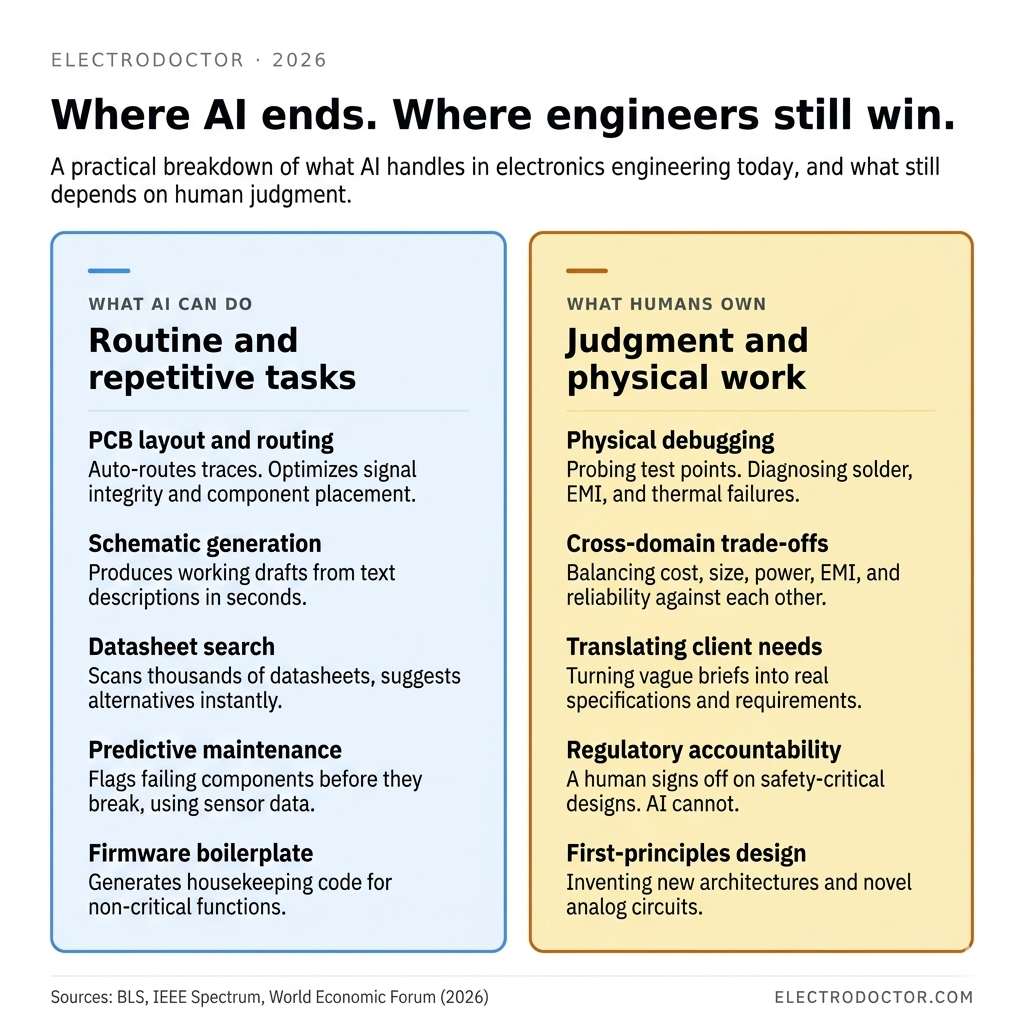
According to the U.S. Bureau of Labor Statistics (BLS) Occupational Outlook Handbook, employment of electrical and electronics engineers is projected to grow **7% from 2024 to 2034**. That is more than double the 3% average for all occupations.
That means about 17,500 new openings every year in the United States alone, for the next ten years.
If AI was about to wipe out the profession, the BLS would not be projecting growth. It would be projecting decline. It is projecting the opposite.
Salaries Are Climbing
-
Median pay for electronics engineers (May 2024): $127,590 per year(BLS)
-
Median pay for electrical engineers (May 2024): $111,910 per year (BLS)
-
Engineers with AI and machine learning skills earn approximately 20% morethan those without (Research.com, 2026)
-
The market is paying more, not less. That is the opposite of what happens to a dying field.
-
The World Economic Forum estimates that nearly 50% of technical engineering tasks could be significantly automated by 2030.
What AI Is Actually Doing in Electronics Engineering Right Now
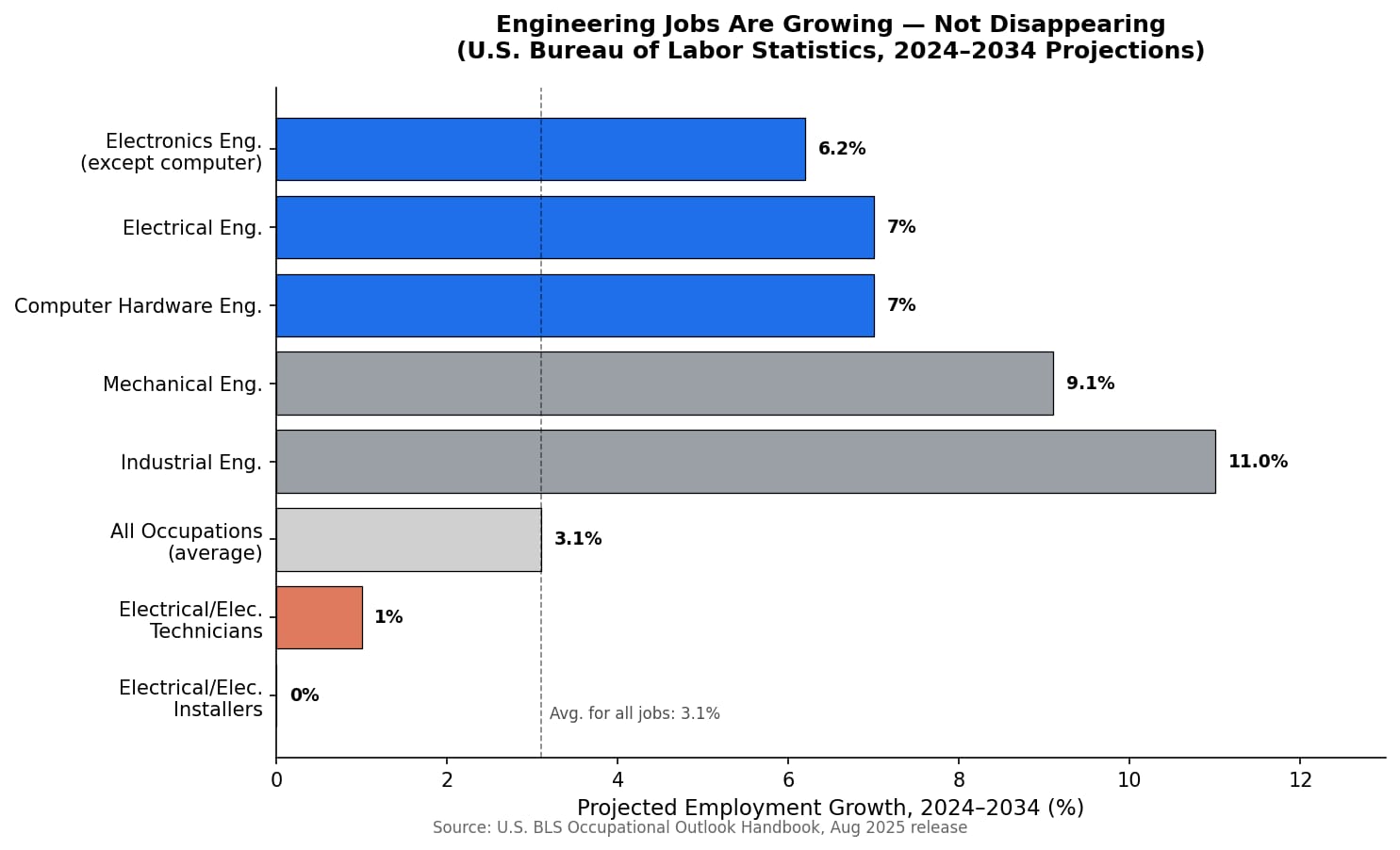
Let's be specific. Here is where AI is already inside the daily work of an electronics engineer in 2026.
1. PCB Design and Layout
AI tools now auto-route PCB traces, optimize signal integrity, and suggest component placement. What took a junior engineer 2 days now takes 2 hours. Cadence, Synopsys, and Siemens EDA all have AI assistants built into their flagship tools.
2. Schematic Generation
Generative AI can produce a first-pass schematic from a text description. It is not always correct. But it gives you a starting point in seconds instead of an afternoon.
3. Component Selection
Searching through datasheets is one of the most boring parts of the job. AI can now scan thousands of datasheets, match specifications, and suggest alternatives — including for parts that are out of stock or end-of-life. This is one of the highest-impact use cases according to engineers at Zühlke and other firms.
4. Predictive Maintenance and Fault Detection
In manufacturing and field deployment, AI models trained on sensor data can predict component failures before they happen. This used to require a senior engineer's intuition. Now it is a vibration sensor and a model.
5. Verification and Test Case Generation
In chip design, AI prioritizes which test cases to run first. This shortens time-to-tape-out, which is the most expensive bottleneck in the industry.
6. Code Assistants for Embedded Systems
GitHub Copilot, Claude, Cursor, and similar tools write firmware boilerplate. They are not perfect for safety-critical code. But for housekeeping functions, they save hours.
.jpeg)
The Tasks AI Cannot Touch (Yet)
Here is where most blogs lie to you with vague promises. Let me be specific instead.
AI struggles badly with:
-
Physical debugging.When a board does not work, the problem is often a bad solder joint, a manufacturing defect, EMI, or a thermal issue. AI cannot put a probe on a test point. AI cannot smell a burning capacitor. AI cannot feel that a heatsink is too hot.
-
Cross-domain trade-offs. A real product has cost, size, power, EMI, regulatory, and reliability constraints that all fight each other. AI optimizes one variable at a time. Engineers balance ten.
-
Ambiguous requirements. Clients say "make it cheaper" or "make it work in the cold." Translating that into actual specifications still requires a human.
-
Accountability.When a medical device kills someone or a power supply burns down a building, a human engineer signs the document. AI does not go to court. AI does not lose a license.
-
First-principles design. AI is good at remixing what already exists. It is bad at inventing what does not exist yet. New chip architectures, new sensor topologies, new analog circuits these still come from human engineers.
This is not a permanent moat. Some of these will erode in 10 years. But for a working engineer planning the next decade, this is your safe ground.
Who Is Most at Risk? An Honest Breakdown
This is the section most articles avoid because it makes readers uncomfortable. We are going to be specific anyway.
High Risk
-
Drafting and CAD technicians.AI does this faster and cheaper. (Research.com, 2026)
-
Routine QA and test engineers doing standardized checks. Automated test systems handle most of this now.
-
Junior engineers doing only "grunt work"— first-pass schematics, basic simulations, simple Bills of Materials. The IEEE Spectrum 2026 report on entry-level jobs says it bluntly: the grunt work that used to be the training ground for new graduates is being eaten by AI. New engineers are now expected to "slot in at a higher level almost from day one."
-
Datasheet researchers and component sourcing specialists doing manual lookups.
Medium Risk
-
Mid-level design engineers working on standard, well-documented product categories where AI training data is abundant.
-
Verification engineers doing repetitive test cycles.
Low Risk
-
Senior engineers with deep system-level understanding.
-
Engineers in safety-critical industries— medical, aerospace, automotive, defense, nuclear.
-
Analog and RF engineers.Training data is scarce, problems are non-standard, and intuition matters more than pattern matching.
-
Hardware security engineers.A growing field, partly because AI itself creates new attack surfaces.
-
Engineers who specialize in AI-enabled hardware (edge AI, neuromorphic chips, AI accelerators).
.png)
The Junior Engineer Problem (This Is Serious)
If AI eats the entry-level work, how do new engineers get experience?
In the old model, you spent 2 to 3 years doing simple tasks. You made small mistakes. You learned how the tools really work. Then you moved up.
In the new model, the simple tasks are done by AI. So either:
1. New graduates need to be much better on day one (which means the education system has to change), or
2. Companies hire fewer juniors and skip straight to mid-level hires (which creates a long-term shortage when seniors retire).
Both are happening. The 2026 NACE Job Outlook survey shows employer sentiment about new graduates is at its most pessimistic since 2020. Hugo Malan, head of science and engineering at Kelly Services, calls it "a tectonic shift."
If you are a student, this affects you. Your degree is not enough anymore. You need:
-
Real hardware projects on your resume (not just simulations).
-
Internships and co-ops, not just GPA.
-
Working knowledge of at least one AI tool relevant to your field.
-
Programming skills — Python and C++ at a minimum.
If you are a parent paying tuition, ask the school how they have updated their curriculum for AI. If they cannot answer, that is a red flag.
What About India, Europe, and Other Markets?
Most of the data above is U.S.-based because the BLS publishes the cleanest numbers. But the trends are global.
India:The semiconductor mission, the rise of GCCs (Global Capability Centers), and the EV push are creating thousands of electronics engineering jobs. AI adoption is happening, but slower than in the U.S. This gives Indian engineers a window — but a closing one.
Europe: Stricter AI regulation (the EU AI Act) means slower automation in safety-critical fields. Good for job security in the short term. Possibly bad for competitiveness in the long term.
East Asia: Taiwan, South Korea, and Japan dominate semiconductor manufacturing. Their engineering jobs are heavily protected by the physical supply chain, which AI cannot relocate.
What You Should Actually Do (Practical Steps)
Stop reading vague advice. Here is a concrete checklist.
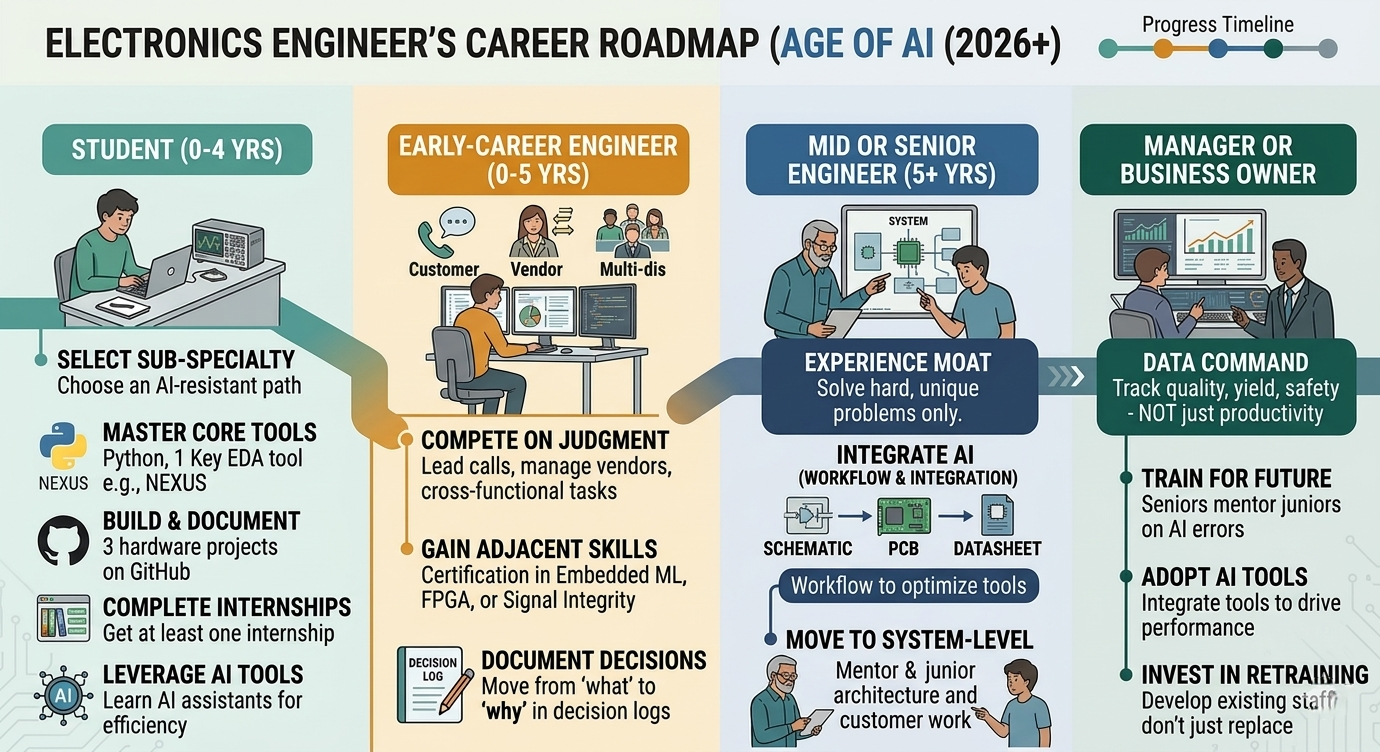
If You Are a Student
1. Pick a sub-specialty that AI cannot easily replicate: analog, RF, power electronics, hardware security, or AI accelerator design.
2. Learn Python and one EDA tool deeply.
3. Build at least three real hardware projects. Document them on GitHub.
4. Do at least one internship before you graduate. Two is better.
5. Get comfortable with at least one AI coding assistant.
If You Are an Early-Career Engineer (0-5 years)
1. Stop competing on speed for routine tasks. AI will win.
2. Start competing on judgment. Volunteer for cross-functional work, customer calls, vendor management.
3. Get one certification in an adjacent skill — embedded ML, FPGA, or signal integrity.
4. Document your decisions, not just your designs. Decision-making is the part AI cannot replicate.
If You Are a Mid or Senior Engineer (5+ years)
1. Your experience is your moat. But only if you keep using it on harder problems.
2. Learn how AI tools fit into your workflow. Use them or be replaced by someone who does.
3. Move toward roles that involve architecture, mentoring, or customer-facing technical work.
4. Avoid roles that are mostly execution. Those are the ones that get squeezed.
If You Are a Manager or Business Owner
1. Adopt AI tools, but track real outcomes — not just productivity metrics.
2. Do not assume "AI = fewer engineers." Most companies are finding they need the same number of engineers, but doing higher-value work.
3. Invest in retraining. Replacing experienced engineers with AI plus juniors usually fails because juniors cannot debug AI's mistakes.
Common Myths That Need to Die
Myth 1: "AI will fully replace electronics engineers in 5 years."
False. The BLS projects job growth, not decline. Physical hardware debugging alone keeps humans essential for at least the next decade.
Myth 2: "If you do not learn AI, you will lose your job tomorrow."
Exaggerated. You will not lose your job tomorrow. But over 5 to 10 years, engineers who use AI will outproduce those who do not. They will be promoted first. The non-AI engineers will plateau.
Myth 3: "AI is just a fancy autocomplete."
Outdated. As of 2026, AI agents can write firmware, run simulations, and iterate on designs without constant human prompting. Underestimating the technology is as dangerous as overestimating it.
Myth 4: "Senior engineers are completely safe."
Mostly true, but not absolute. Senior engineers whose seniority is mostly "I know all the old tools" are vulnerable. Senior engineers whose seniority is "I know how to make hard trade-offs and lead teams" are very safe. Know which one you are.
Myth 5: "AI will create more jobs than it destroys."
Possibly true on aggregate. Probably false for specific individuals. The new jobs will not be in the same place, at the same level, with the same skill set as the old jobs. "Net positive" for the economy can still mean "net negative" for you personally if you do not adapt.
The Real Risks Most People Are Ignoring
Most articles end with "the future is bright!" Let's not do that. Here are the real risks worth thinking about.
-
Wage compression in the middle.AI lifts top earners and squeezes mid-level pay. This pattern is already showing up in software engineering and is starting to appear in hardware.
-
Loss of tacit knowledge. When juniors do not do simple tasks, they do not develop intuition. In 15 years, we may have a shortage of engineers who can debug strange hardware problems, because nobody trained on the simple ones.
-
Over-reliance on AI suggestions.Engineers signing off on AI-generated designs they do not fully understand is a real safety risk. We will see at least one major product recall or safety incident in the next 5 years that traces back to this.
-
Concentration of power. A small number of EDA and AI vendors will own the tools. That changes the economics of the industry in ways we do not fully understand yet.
These are not reasons to panic. They are reasons to plan.
Final Verdict
Will AI replace electronics engineers? No. Not as a profession.
Will AI replace electronics engineers who refuse to adapt? Yes. Slowly, then suddenly.
Will the job look the same in 10 years? Absolutely not.
The electronics engineer of 2035 will spend less time drawing schematics and more time defining problems, validating AI outputs, integrating systems, and making judgment calls. They will earn more on average. But there will be fewer purely "execution" roles, and the skill bar will be higher than it has ever been.
The choice is yours. Your career is not going to be saved by an article. It is going to be saved by what you do in the next 12 months.
Frequently Asked Questions
Q: Will AI replace electronics engineers by 2030?
No. The U.S. Bureau of Labor Statistics projects 7% job growth from 2024 to 2034, faster than the average occupation. AI will replace specific tasks inside the role, not the role itself.
Q: Should I still study electronics engineering in 2026?
Yes, if you are willing to pair it with programming, AI tools, and at least one specialty (analog, RF, power, embedded ML, or hardware security). A pure traditional EE degree without these is a weaker bet than it was 10 years ago.
Q: Which electronics engineering jobs are safest from AI?
Analog and RF design, hardware security, safety-critical industries (medical, aerospace, automotive, nuclear), and senior system architects.
Q: How much do electronics engineers earn in 2026?
The U.S. median for electronics engineers is around $127,590 per year (BLS, May 2024). Engineers with AI skills earn roughly 20% more.
Q: Can AI design a chip from scratch?
Not from scratch. AI assists at almost every stage now, but human engineers still define the architecture, set goals, and make trade-offs. Fully autonomous chip design is a research goal, not a 2026 reality.
Q: Should junior engineers be worried?
Worried, no. Alert, yes. The traditional junior path of learning through simple repetitive work is shrinking. New engineers need to bring more skills on day one, including AI fluency, programming, and hands-on hardware experience.
Sources Used in This Article
-
U.S. Bureau of Labor Statistics, Occupational Outlook Handbook (2024-2034 projections)
-
IEEE Spectrum, "AI Shifts Expectations for Entry Level Jobs" (2026)
-
World Economic Forum, Future of Jobs Report
-
Semiconductor Engineering, "AI's Impact On Engineering Jobs" (2026)
-
Research.com, "AI, Automation, and the Future of Electrical Engineering" (2026)
-
Zühlke Engineering, "How AI is reshaping careers in electronics engineering" (2025)
-
NACE Job Outlook 2026 Survey