Last updated: 2026
Every phone, car, satellite and insulin pump is the work of a chain of electronics specialists. Here is what each of the twelve core roles actually does, the skills it rewards, and what it pays grounded in 2024 U.S. government wage data.
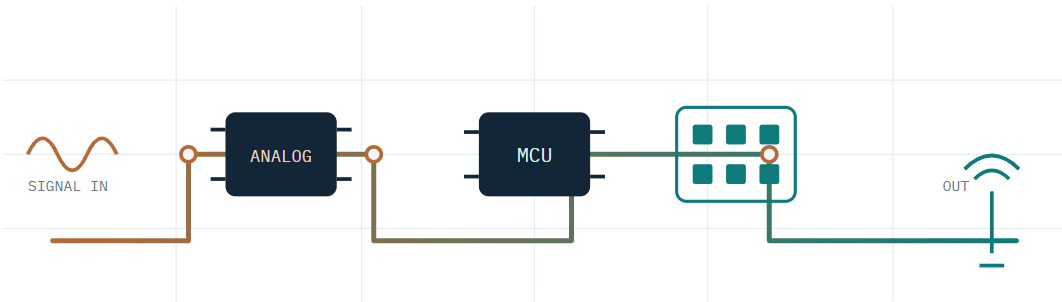
A single product touches most of these roles. A sensor reading is conditioned by an analog engineer's circuit, digitised, processed on a microcontroller written by firmware and embedded engineers, laid out by a PCB designer, verified by a test engineer, and sent over the air by an RF engineer.
What Each Engineer Does: A Quick Overview of the 12 Engineering Roles
1.Hardware Engineer
Designs and debugs the electronic circuits behind a product.
The generalist of the hardware world. A hardware engineer chooses components, draws the schematic, powers up the first prototype and then spends a lot of time with a scope figuring out why reality disagrees with the design. They sit between the analog and digital specialists and pull the pieces into one working board.
Day to day :Component selection, schematic capture, bring-up of new boards, signal-integrity debugging, design reviews, working with manufacturers.
Key skills :Circuit design, Schematics, Oscilloscope, debug, Datasheets
Tools :Altium / KiCad / OrCAD, lab bench (scope, DMM, power supply, logic analyser).
2.PCB Design Engineer
Turns a schematic into a physical board a factory can build.
A schematic says what connects to what; the PCB engineer decides where and how. That means placing hundreds of parts, routing copper so high-speed signals stay clean, managing heat and electromagnetic interference, and preparing the manufacturing files. On dense or high-frequency boards, layout is where a design succeeds or quietly fails.
Day to day: Placement, multi-layer routing, impedance control, DFM (design-for-manufacture) checks, generating Gerbers and BOMs.
Key skills: PCB layout, Signal integrity, EMI/EMC, Stack-up design
Tools: Altium Designer, Cadence Allegro, Mentor Xpedition, KiCad.
3.Power Electronics Engineer
Designs supplies, converters and motor-control systems.
Where most electronics deals in milliamps, power electronics deals in amps and kilowatts converting and controlling energy efficiently without melting anything. It is central to the two biggest hardware stories of the decade: electric vehicles (battery management, inverters, motor drives) and the grid and data-centre buildout. Demand here is unusually strong.
Day to day: Designing switch-mode supplies and converters, motor-drive control, thermal management, efficiency and safety compliance.
Key skills: SMPS designMagneticsControl loopsThermal design
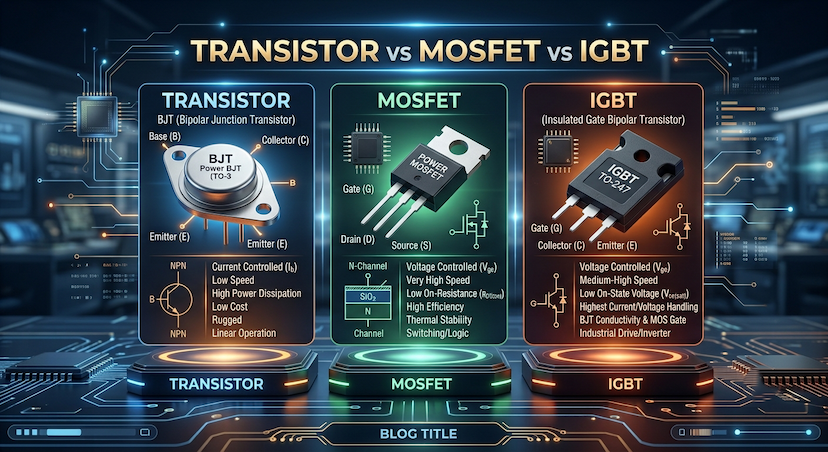
Tools: LTspice/PLECS, power analysers, gate-driver and MOSFET/GaN/SiC datasheets.
4.Embedded Engineer
Writes software that runs on microcontrollers and reads sensors.
Embedded engineers write the code that lives inside devices with no keyboard and no screen a thermostat, a drone, a car's brake controller. The constraints are the whole game: tiny memory, no operating system or a small real-time one, and code that must respond in microseconds and never crash. This is one of the largest and most in-demand electronics careers, powered by IoT, automotive and medical devices.
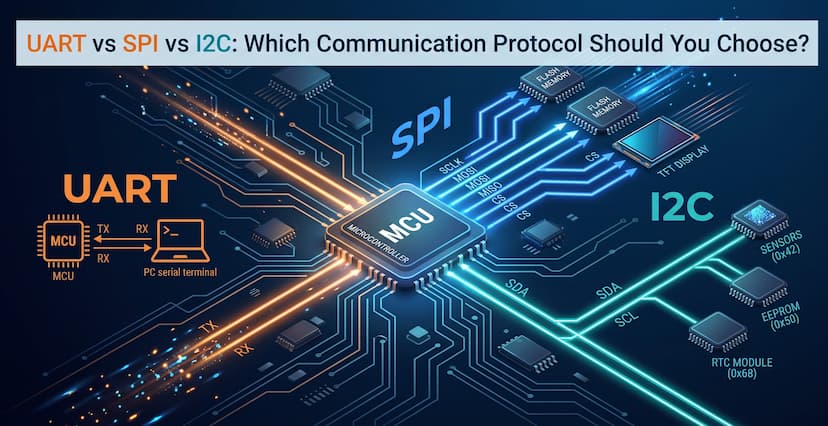
Day to day: Writing C/C++ for microcontrollers, integrating sensors and communication buses (I2C, SPI, UART, CAN), tuning an RTOS, debugging on real hardware.
Key skills: Embedded C/C++, RTOS, Microcontrollers, Sensor buses
Tools: ARM toolchains, FreeRTOS/Zephyr, JTAG debuggers, logic analysers.
5.Analog Design Engineer
Designs and optimises continuous-signal, non-digital circuits.
Digital pretends the world is ones and zeros; analog deals with the messy reality in between. Analog engineers design amplifiers, data converters, sensor front-ends and reference circuits the parts that decide how faint a signal you can read and how much noise you can tolerate. It is widely considered the hardest electronics discipline to master, because so little of it can be abstracted away. That scarcity is exactly why it pays well.
Day to day: Designing amplifiers, ADCs/DACs and references, noise and stability analysis, transistor-level design, careful characterisation.
Key skills: Analog IC design, Transistor physics,Noise analysis,SPICE
Tools: Cadence Virtuoso/Spectre, LTspice, precision lab instruments.
6.FPGA / ASIC Design Engineer
Builds custom, high-performance digital logic circuits.
When a general-purpose processor is too slow or too power-hungry, engineers build the logic themselves. FPGAs are reconfigurable chips; ASICs are custom silicon manufactured for one purpose. Both are described in hardware-description languages (Verilog, VHDL) rather than "programmed" in the usual sense. This is a demanding, well-paid specialism at the heart of AI accelerators, networking, defence and high-speed instruments.
Day to day: Writing RTL, timing closure, functional verification, synthesis and place-and-route, working with high-speed interfaces.
Key skills: Verilog / VHDL, Digital design, Timing analysis, Verification
Tools: Xilinx/AMD Vivado, Intel Quartus, Synopsys/Cadence toolchains, SystemVerilog/UVM.
7.Firmware Engineer
Writes the lowest-level code that directly controls the hardware.
Firmware is the layer where software meets silicon. Firmware engineers write boot code, drivers and the routines that poke individual registers to make a chip do something. Where an embedded engineer might build a whole product, a firmware engineer often goes deeper and narrower bring-up of a brand-new board, a driver for a new sensor, or the power-management code nobody else wants to touch.
Day to day: Board bring-up, writing drivers, register-level programming, bootloaders, interrupt handlers, low-level optimisation.
Key skills: C / assembly, Register-level work, DriversDebugging
Tools: GCC/LLVM, GDB/OpenOCD, oscilloscopes and logic analysers, chip reference manuals.
8.Test Engineer
Catches faults before a product reaches customers.
Every design fails in ways nobody predicted; the test engineer's job is to find those failures cheaply, in the lab, rather than expensively, in the field. They build the rigs and scripts that stress a product against temperature, voltage, vibration and misuse, and they design the fast go/no-go tests that run on every unit coming off the line.
Day to day: Writing test plans, building automated test fixtures, running validation and reliability tests, analysing failures, feeding fixes back to design.
Key skills: Test automation, Python/LabVIEW, Instrumentation, Statistics
Tools: Automated test equipment (ATE), Python, LabVIEW, environmental chambers.
9.DSP Engineer
Analyses and manipulates digital signals to improve performance.
Once a signal is digitised, DSP engineers do the maths that makes it useful filtering out noise, compressing audio and video, detecting a heartbeat in a noisy trace, or picking a voice out of a crowded room. The work sits between algorithm design and efficient implementation, and it underpins audio, communications, radar, imaging and a lot of modern machine learning at the edge.
Day to day: Designing filters and transforms, developing and testing algorithms in MATLAB/Python, then porting them to run efficiently on a DSP or FPGA.
Key skills: Signal processing, Filter design, MATLAB/Python, Fixed-point maths
Tools: MATLAB/Simulink, Python (NumPy/SciPy), TI/Analog Devices DSP toolchains.
10.Design Verification Engineer
Proves a chip design is correct before a cent is spent on silicon.
In chip design, catching a bug after manufacture can cost millions and months. So verification engineers build elaborate simulated testbenches that hammer a design with every legal and illegal input before it is ever fabricated. In many semiconductor teams there are more verification engineers than designers — it is one of the largest and most secure roles in the field, and it is coded rather than soldered.
Day to day: Writing testbenches and constrained-random stimulus, building coverage models, chasing corner-case bugs, closing coverage before tape-out.
Key skills: SystemVerilog / UVMDigital design senseScriptingCoverage analysis
Tools: Synopsys VCS, Cadence Xcelium, Mentor Questa, Python/Perl.
11.Physical Design Engineer (VLSI Backend)
Turns chip logic into an actual, manufacturable silicon layout.
If the FPGA/ASIC engineer writes what the logic does, the physical-design engineer decides where every gate sits on the die and how signals route between them while meeting brutal targets for timing, power and area. It is the semiconductor equivalent of PCB layout, but at nanometre scale and with billions of transistors. Highly tool-driven and highly paid.
Day to day: Floorplanning, placement, clock-tree synthesis, routing, timing and power closure, sign-off checks.
Key skills: STA (timing)Place & routeLow-power designTcl scripting
Tools: Synopsys Fusion Compiler/ICC2, Cadence Innovus, PrimeTime.
12.Validation Engineer (Post-Silicon)
Checks that the real first chips and prototypes behave as designed.
Simulation only proves the model; validation proves the physical part. When first silicon or a new prototype arrives, validation engineers put it on the bench, run it across voltage, temperature and speed, and find the gaps between "worked in the simulator" and "works in the world". It differs from a test engineer, whose focus is the fast pass/fail screen on the production line
Day to day: Post-silicon bring-up, characterisation across corners, debugging real failures, feeding issues back to design and to production test.
Key skills: Lab instrumentation, Debugging, Scripting, Data analysis
Tools: High-end scopes, protocol analysers, thermal chambers, automated bench setups.
13.Signal & Power Integrity Engineer
Keeps ultra-fast signals clean and power rails steady on dense boards.
As data rates climb into the gigabits DDR memory, PCIe, high-speed SerDes, the interconnects inside AI servers a copper trace stops behaving like a wire and starts behaving like a transmission line. SI/PI engineers simulate and measure this behaviour so the "eye" stays open and the power delivery network stays quiet. It is a fast-growing specialism riding the data-centre and AI-hardware boom.
Day to day: Channel and power-delivery simulation, controlled-impedance stack-ups, decoupling design, eye-diagram and TDR measurement.
Key skills: High-speed design, EM simulation, S-parameters, PDN analysis
Tools: ANSYS/Keysight/Cadence SI tools, high-bandwidth scopes, VNAs.
14.Battery / BMS Engineer
Designs the systems that keep large battery packs safe, efficient and long-lived.
Electric vehicles and grid storage turned the battery from a component into a system. Battery-management engineers design the electronics and algorithms that monitor every cell, balance charge, estimate remaining range and above all prevent the thermal runaway that makes headlines. It sits at the crossroads of power electronics, embedded software and safety engineering, and demand has exploded with the EV and energy-storage boom.
Day to day: BMS hardware and firmware, cell modelling, state-of-charge/health estimation, thermal and safety design, functional-safety compliance.
Key skills: Battery chemistry basicsPower electronicsEmbedded controlISO 26262
Tools: Battery cyclers, cell simulators, MATLAB/Simulink, embedded toolchains.
15.Battery / BMS Engineer
Designs the systems that keep large battery packs safe, efficient and long-lived.
Electric vehicles and grid storage turned the battery from a component into a system. Battery-management engineers design the electronics and algorithms that monitor every cell, balance charge, estimate remaining range and above all prevent the thermal runaway that makes headlines. It sits at the crossroads of power electronics, embedded software and safety engineering, and demand has exploded with the EV and energy-storage boom.
Day to day: BMS hardware and firmware, cell modelling, state-of-charge/health estimation, thermal and safety design, functional-safety compliance.
Key skills: Battery chemistry basics, Power electronics, Embedded control, ISO 26262
Tools: Battery cyclers, cell simulators, MATLAB/Simulink, embedded toolchains.
16.EMC / Compliance Engineer
Gets a product legally cleared to ship and stops it interfering with everything else.
A device can work perfectly on your bench and still be illegal to sell. Every product must pass electromagnetic-compatibility and safety rules (FCC, CE, and their equivalents) — it must not spray interference, and it must survive the interference around it. The compliance engineer designs for that from the start and shepherds the product through certification. Quietly essential, and frequently the reason a launch slips.
Day to day: Pre-compliance testing, shielding and filtering fixes, running certification test campaigns, managing regulatory documentation.
Key skills: EMI/EMC, Regulatory standards, Grounding/shielding, Root-cause debug
Tools: EMC chambers, spectrum analysers, near-field probes, LISNs.
17.Manufacturing / Production Engineer
Takes a working prototype and makes a million of it, reliably and cheaply.
A design that works once is not a product; a product is a design that works ten thousand times a day on a factory line. Manufacturing engineers own that leap the assembly process, the SMT line, the yield, the cost, and the "new product introduction" (NPI) hand-off from R&D to the factory. It is one of the largest employment areas in electronics and the backbone of the current push to reshore chip and hardware production.
Day to day: Designing and tuning assembly processes, improving yield, reducing cost, NPI ramp-ups, working with contract manufacturers.
Key skills: SMT / assemblyProcess control, DFMLean / Six Sigma
Tools: Pick-and-place and reflow lines, AOI, SPC and MES software.
18.Robotics / Mechatronics Engineer
Fuses electronics, mechanics and control software into machines that move.
Robotics is where electronics stops being static. Mechatronics engineers combine motors, sensors, power and control code so a system can sense its environment and act on it factory arms, drones, autonomous machines, surgical robots. It is inherently cross-disciplinary, which is exactly its appeal and its difficulty: you need enough of three fields to make them cooperate.
Day to day: Motor and actuator control, sensor fusion, real-time control loops, integrating mechanical, electrical and software subsystems.
Key skills: Control theory, Embedded C/C++, Sensors & actuators, ROS
Tools: ROS, MATLAB/Simulink, motor drivers, embedded and CAD toolchains.
19.IoT Engineer
Connects embedded devices to the network, the cloud and each other securely, at scale.
An IoT engineer builds on embedded foundations but owns everything that happens once a device goes online: choosing the wireless link, getting data reliably to a backend, provisioning and updating a fleet of thousands of devices in the field, and keeping the whole thing secure. In plain terms much of this job is embedded engineering; what sets it apart is the network, data and security stack layered on top. It has become one of the highest-volume hiring areas in electronics as sensors spread into homes, factories, farms and cities.
Day to day: Firmware for connected devices, integrating wireless links, wiring devices to cloud backends, over-the-air (OTA) updates, device security and fleet management.
Key skills: Embedded C +, PythonWireless (BLE/Wi-Fi/LoRa/cellular), MQTT / cloud, IoTDevice security
Tools: MQTT/CoAP, AWS IoT / Azure IoT, BLE/LoRa/cellular modules, edge and OTA frameworks.
20.Systems Engineer
Connects hardware, software and requirements into one coherent product.
Someone has to own the whole. Systems engineers translate "what the product must do" into a partitioned design what runs in hardware, what runs in software, how the blocks talk, and how you prove it all meets spec. They live in requirements, interfaces and trade-offs, and they are the people who catch the integration problems that no single specialist would have seen.
Day to day: Writing and tracing requirements, defining architecture and interfaces, managing trade-offs, coordinating specialists, verification planning.
Key skills: RequirementsArchitectureSystems thinkingMBSE
Tools: DOORS/Jama, SysML tools, plus fluency across the hardware and software domains.
What these roles pay
The BLS does not publish a separate wage for "FPGA engineer" or "firmware engineer". It groups them into broader categories. The honest way to read pay is to see where each role maps, then adjust for your specialism, industry and location.
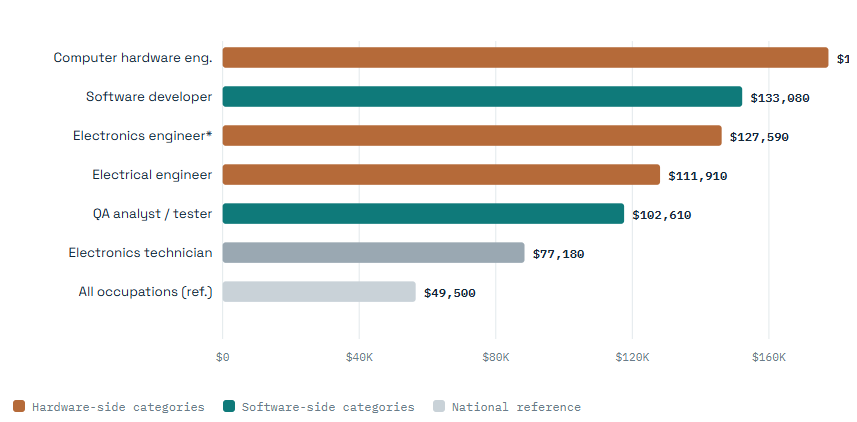
Which electronics job role pays the most?
Of the BLS categories these roles map to, "computer hardware engineers" had the highest median wage at $155,020 in May 2024. In practice, though, the strongest individual offers tend to go to scarce specialists — analog IC designers, RF engineers and FPGA/ASIC engineers because the talent pool is small and hard to replace.