
Last updated: 2026
Embedded firmware is what makes the physical world smart. The brake system in your car, the pacemaker in someone's chest, the drone hovering overhead, the smart watch on your wrist. All of them run on firmware written by someone. That someone could be you.
But the path from beginner to professional firmware engineer is not obvious. Most online guides list 50 skills with no priority and no timeline. You finish reading and still don't know what to do on Monday morning.
This roadmap is different. It is structured in six phases, with realistic time estimates, specific projects, and the exact skills that hiring managers look for. Follow it in order. Skip a phase and you will hit a wall later.
Who This Roadmap Is For
This guide is for you if:
-
You are a student or career-changer looking at embedded systems
-
You can code a bit but have never touched real hardware
-
You have done Arduino projects but want to go deeper
-
You want a job, not just a hobby
This is not for you if you only want to use high-level Arduino libraries forever. Production firmware engineering requires understanding what happens below those libraries.
What Does an Embedded Firmware Engineer Actually Do?
A firmware engineer writes code that runs directly on microcontrollers and embedded processors. The code controls hardware, reads sensors, talks to other devices, and runs continuously from the moment power is applied until power is removed.
Here is the system you will be working with:
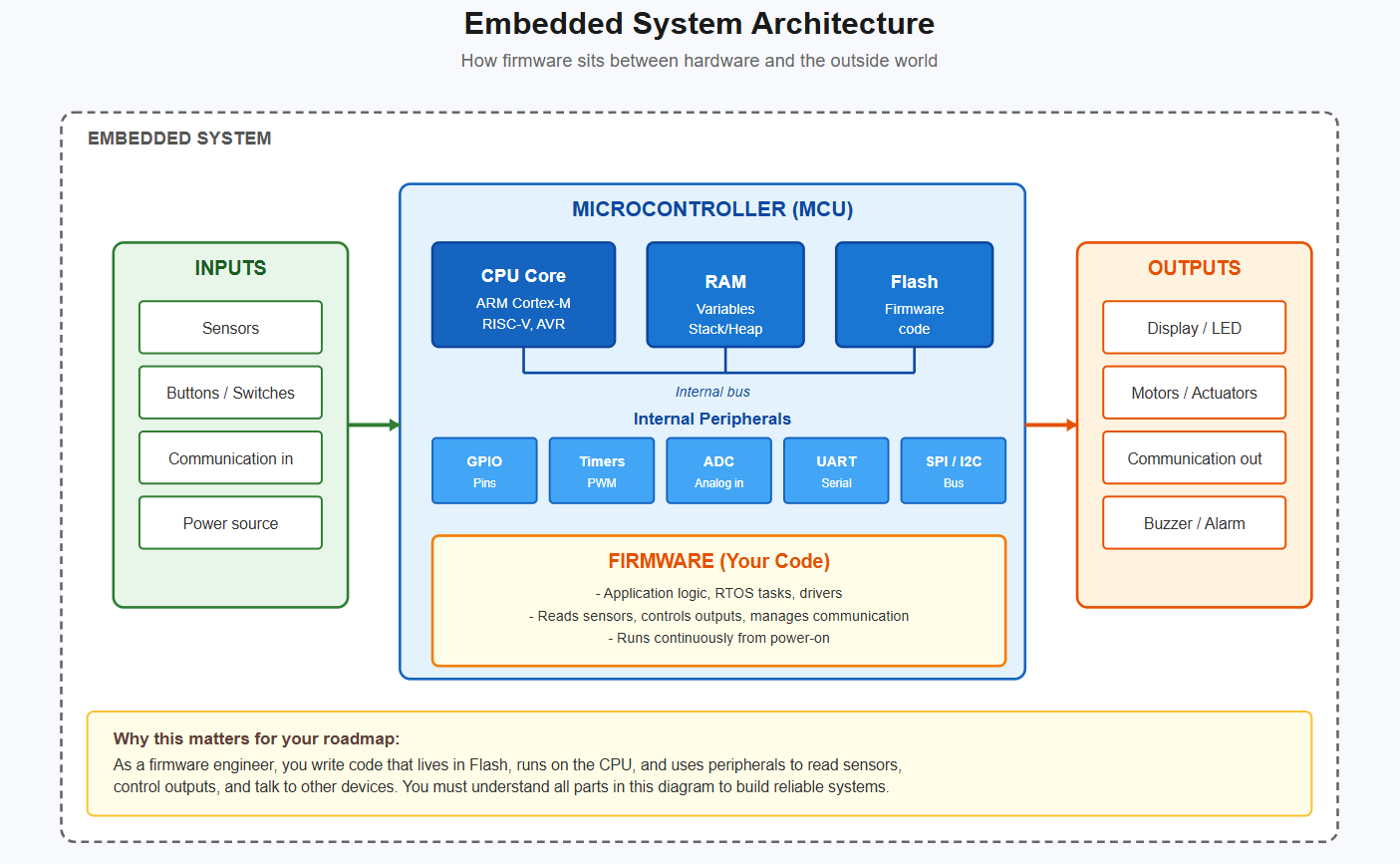
Your code lives in Flash memory. It runs on the CPU. It uses peripherals like GPIO, timers, ADC, and communication buses to read inputs (sensors, buttons, network messages) and drive outputs (motors, displays, alarms, network messages back out).
Every part of this diagram matters. The roadmap below teaches you each piece in the right order.
The Skill Stack: What You Need to Learn
Embedded firmware skills form a stack. Each layer depends on the layer below it. If you skip Layer 1 and jump to Layer 4, you will struggle with bugs that take days to find because you do not have the foundation to reason about them.
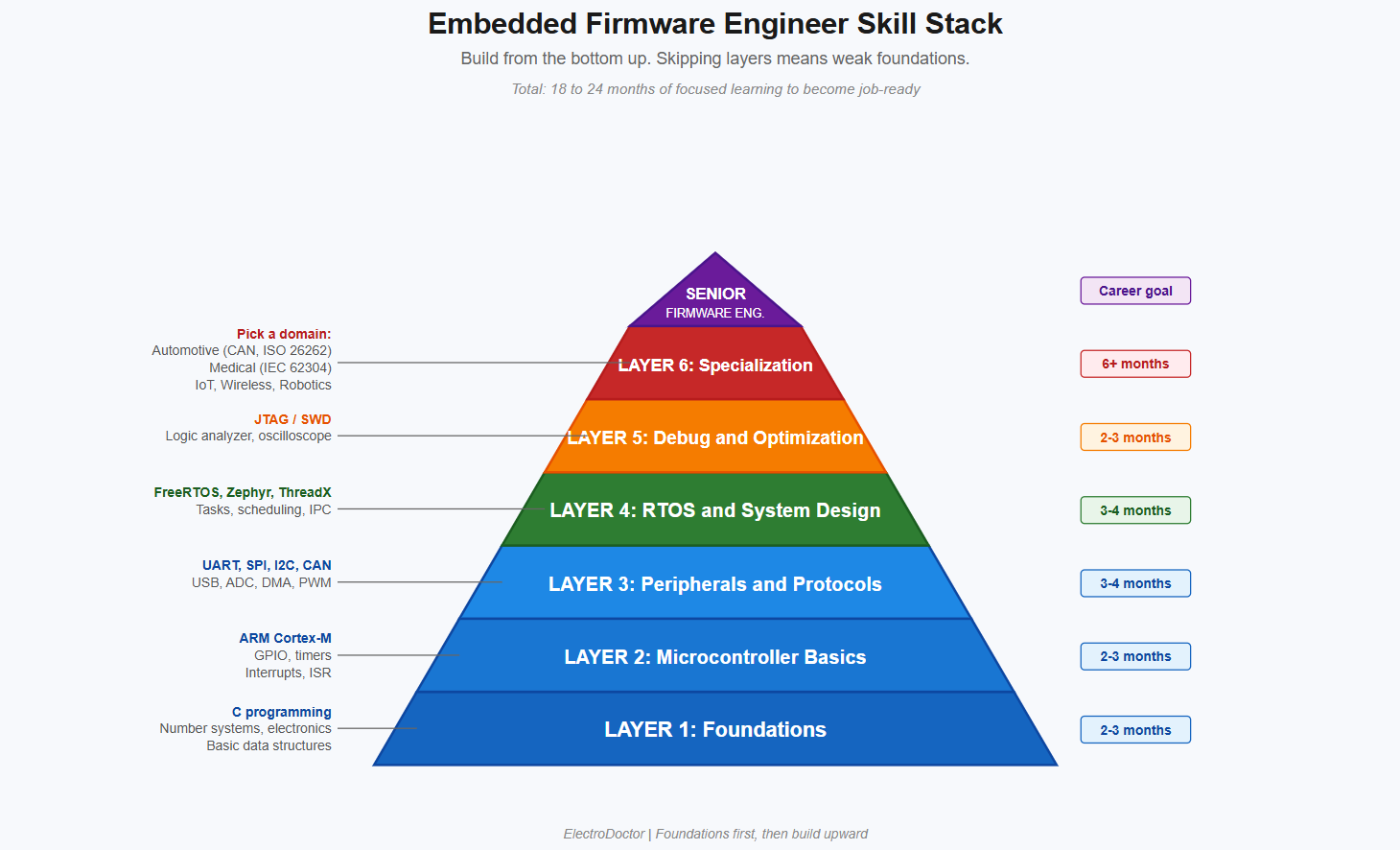
Total time to reach job-ready: roughly 18 to 24 months of focused, consistent learning. Faster is possible if you study full time. Slower is normal if you have a day job.
The 6-Phase Roadmap
This is the heart of the guide. Six phases, each with a clear goal, a set of skills, and a project to prove you learned it.
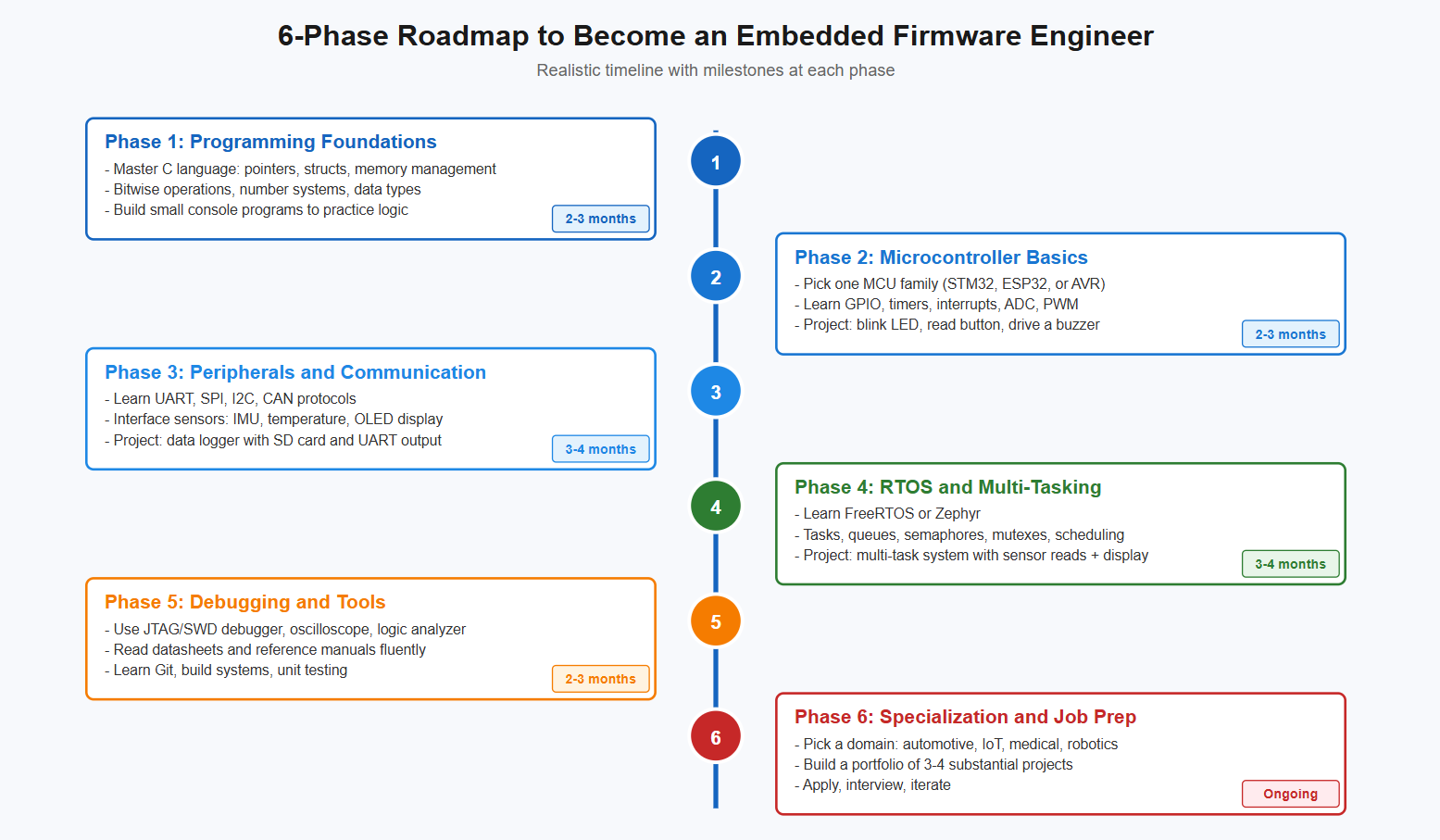
Phase 1: Programming Foundations (2-3 months)
Before you touch any hardware, you must be comfortable with C.
C remains the dominant language in embedded systems because it gives you direct control over memory, fits in small flash chips, and produces fast, predictable code. C++ is also used, but C is the foundation.
What to master:
-
Variables, data types, operators
-
Control flow (if, while, for, switch)
-
Functions and parameter passing
-
Pointers (this is the most important topic — do not skip)
-
Arrays and strings
-
Structs, unions, enums
-
Bitwise operations (AND, OR, XOR, shifts)
-
Memory layout: stack, heap, global, static
-
Preprocessor directives
How to practice:
Write small programs on your PC first. Build a calculator, a basic file parser, a linked list implementation. Get comfortable with the language before adding hardware to the mix.
Common mistake:
Many beginners skip C basics and jump straight to Arduino. Arduino hides the complexity. When something breaks, you will not know how to debug it.
Phase 2: Microcontroller Basics (2-3 months)
Now pick one microcontroller family and learn it deeply. Do not jump between platforms.
Recommended choices:
-
STM32 (ARM Cortex-M) — Most common in industry. Great tooling with STM32CubeIDE. Good for serious work.
-
ESP32 — Powerful, has WiFi and Bluetooth built in. Good for IoT.
-
AVR (Arduino Uno) — Easiest start, but limited. Only use as a stepping stone.
What to learn:
-
The MCU architecture (CPU, RAM, Flash, registers)
-
Reading the reference manual and datasheet
-
Setting up a toolchain and IDE
-
GPIO: controlling pins, reading inputs
-
Timers: delays, periodic interrupts, time measurement
-
Interrupts and interrupt service routines (ISR)
-
ADC (analog to digital conversion)
-
PWM (pulse width modulation)
-
Projects to build:
-
Blink an LED (the classic first project)
-
Button-controlled LED with debouncing
-
PWM-controlled servo motor
-
ADC-based light meter or potentiometer reader
The goal is to start writing code at the register level as well as using HAL libraries. Knowing how to manipulate registers directly is what separates a firmware engineer from a hobbyist.
Phase 3: Peripherals and Communication Protocols (3-4 months)
Now you learn how MCUs talk to other chips. This is where embedded gets interesting and where most engineers spend their daily work.
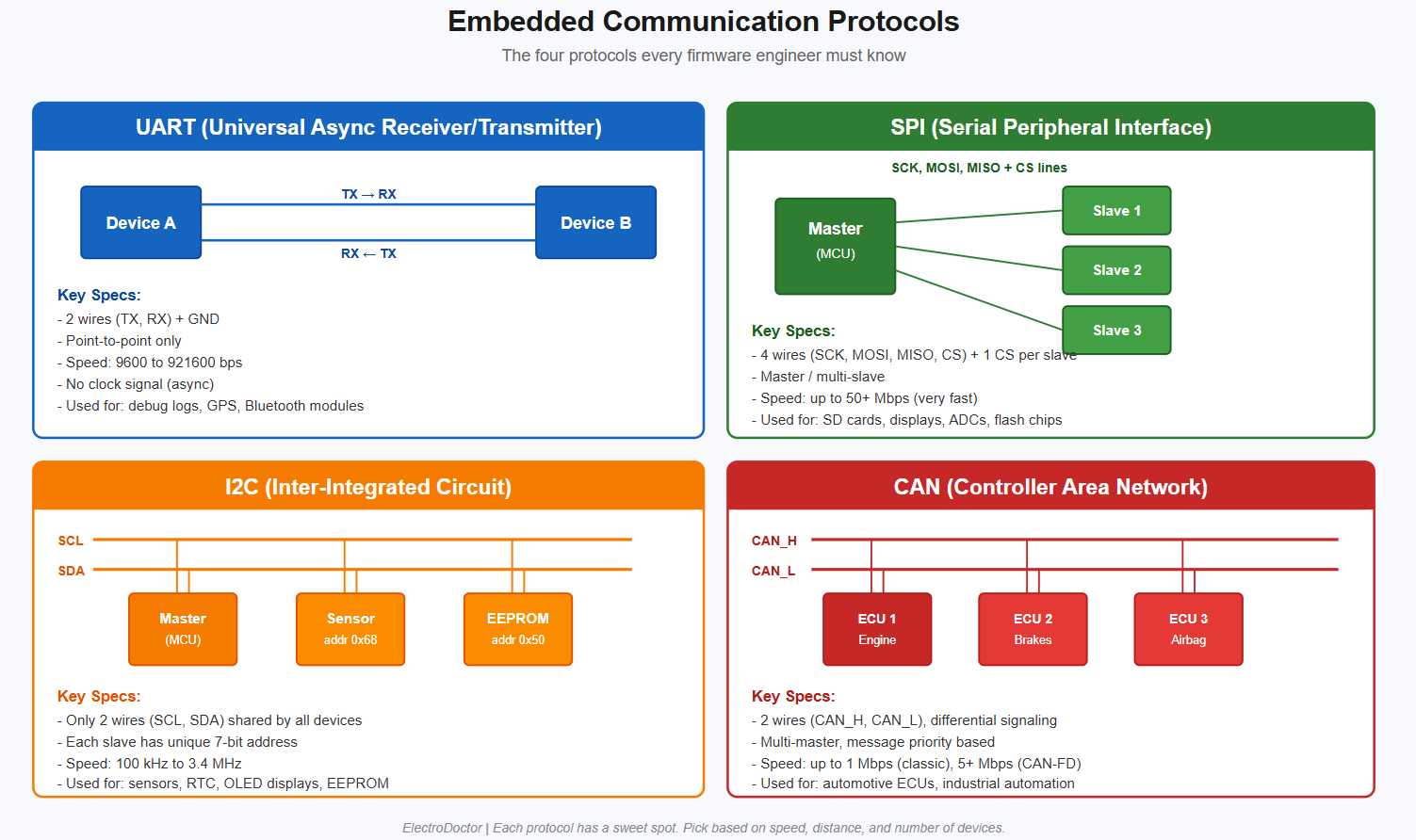
The four protocols every firmware engineer must know:
-
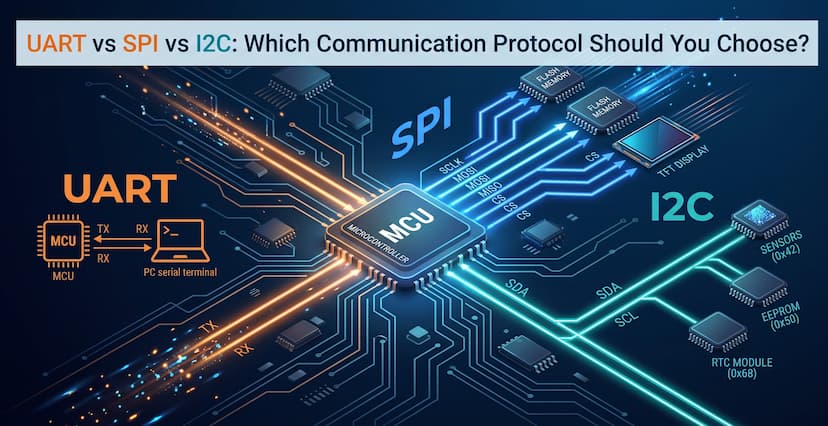
UART — The simplest. Two wires, point-to-point. Used for debug logs, GPS modules, Bluetooth modules.
-
SPI — Fast and parallel-friendly. Four wires plus one chip-select per slave. Used for SD cards, displays, fast ADCs, flash memory.
-
I2C — Two wires shared by many devices. Each device has an address. Used for sensors, real-time clocks, EEPROM, OLED displays.
-
CAN — Differential signaling, multi-master, prioritized. Used in cars, industrial machines, robots.
Practice projects:
-
Connect an I2C sensor (BMP280, MPU6050) and print readings over UART
-
Drive an SPI OLED display
-
Build a CAN bus node if you have an automotive-focused goal
-
Build a data logger that reads sensors and writes to an SD card
-
You should also learn USB, DMA, and EEPROM/Flash usage in this phase. They show up in almost every real product.
Phase 4: RTOS and System Design (3-4 months)
Bare-metal code is fine for simple projects. But once you need to do many things at once — read sensors, update a display, talk to a network, handle user input — you need an RTOS (Real-Time Operating System).
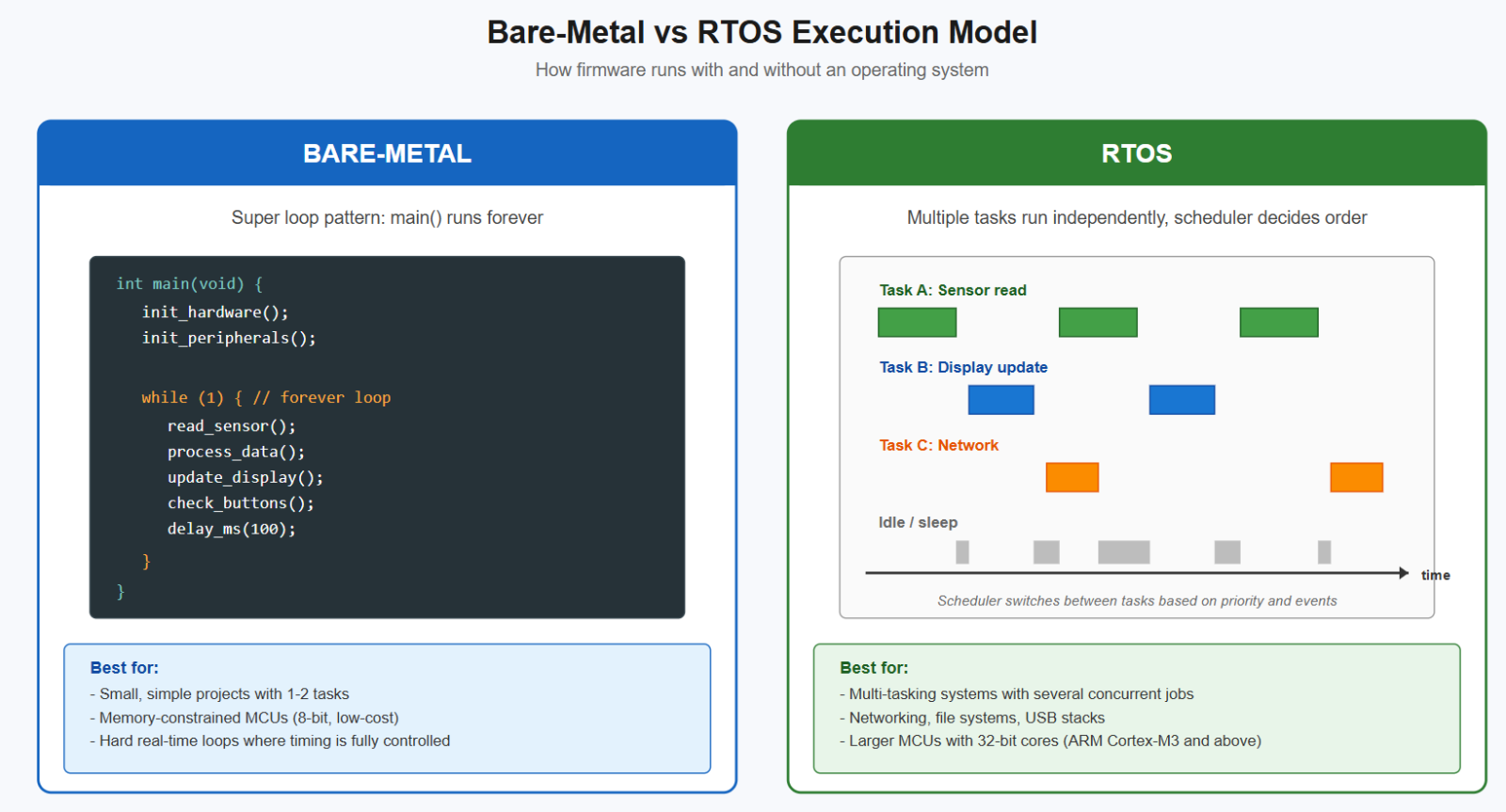
In bare-metal, your code runs in a single super loop. Everything happens in sequence. If one task is slow, everything else waits.
In an RTOS, you create tasks. Each task is like a small program that runs independently. The RTOS scheduler decides which task runs at any moment, based on priority and events.
Which RTOS to learn:
-
FreeRTOS - Most popular open-source RTOS. Lightweight, easy to learn, huge community. Start here.
-
Zephyr - Backed by the Linux Foundation, growing fast. Supports many architectures (ARM, RISC-V, x86, ARC).
-
ThreadX (Azure RTOS) - Microsoft-backed, commercial-grade, certified for safety-critical systems.
Phase 5: Debugging, Tools, and Engineering Practices (2-3 months)
This phase separates hobbyists from professionals.
Tools to learn:
-
JTAG / SWD debugger — Hardware-level debugging. Set breakpoints, step through code, inspect registers. ST-Link or J-Link are common.
-
Oscilloscope — Read electrical signals. Verify timing, debug protocols.
-
Logic analyzer — Capture digital signals. Decode UART, SPI, I2C buses to find protocol bugs.
-
Multimeter — Check voltages, continuity. The most-used tool in any lab.
Software practices:
-
Git — Version control is non-negotiable. Learn branching, merging, pull requests.
-
Build systems — Make, CMake. Understand how source files become binaries.
-
Static analysis — Tools like cppcheck and clang-tidy catch bugs before they ship.
-
Unit testing — Yes, you can test firmware. Frameworks like Unity and Ceedling help.
-
MISRA C — A coding standard required in automotive and medical. Learn it if you want those jobs.
Mindset shift:
You also need to learn how to read datasheets cover to cover, write requirements, and review other people's code. These are not glamorous skills, but they are what real engineers do every day.
Phase 6: Specialization and Job Prep (Ongoing)
By now you have the core skills. The question is where to apply them.
Common domains:
-
Automotive — CAN, ISO 26262 functional safety, AUTOSAR. Big industry, strict process, good pay.
-
Medical devices — IEC 62304 software lifecycle, FDA regulations. High responsibility.
-
IoT and consumer electronics — BLE, WiFi, MQTT, cloud integration. Fast-moving, lots of startups.
-
Industrial automation — Modbus, OPC-UA, PLCs. Stable, less hyped, well paid.
-
Aerospace and defense — DO-178C, RTOS certification. Hard to enter without clearance.
-
Robotics — Motor control, sensor fusion, real-time loops. Increasingly important.
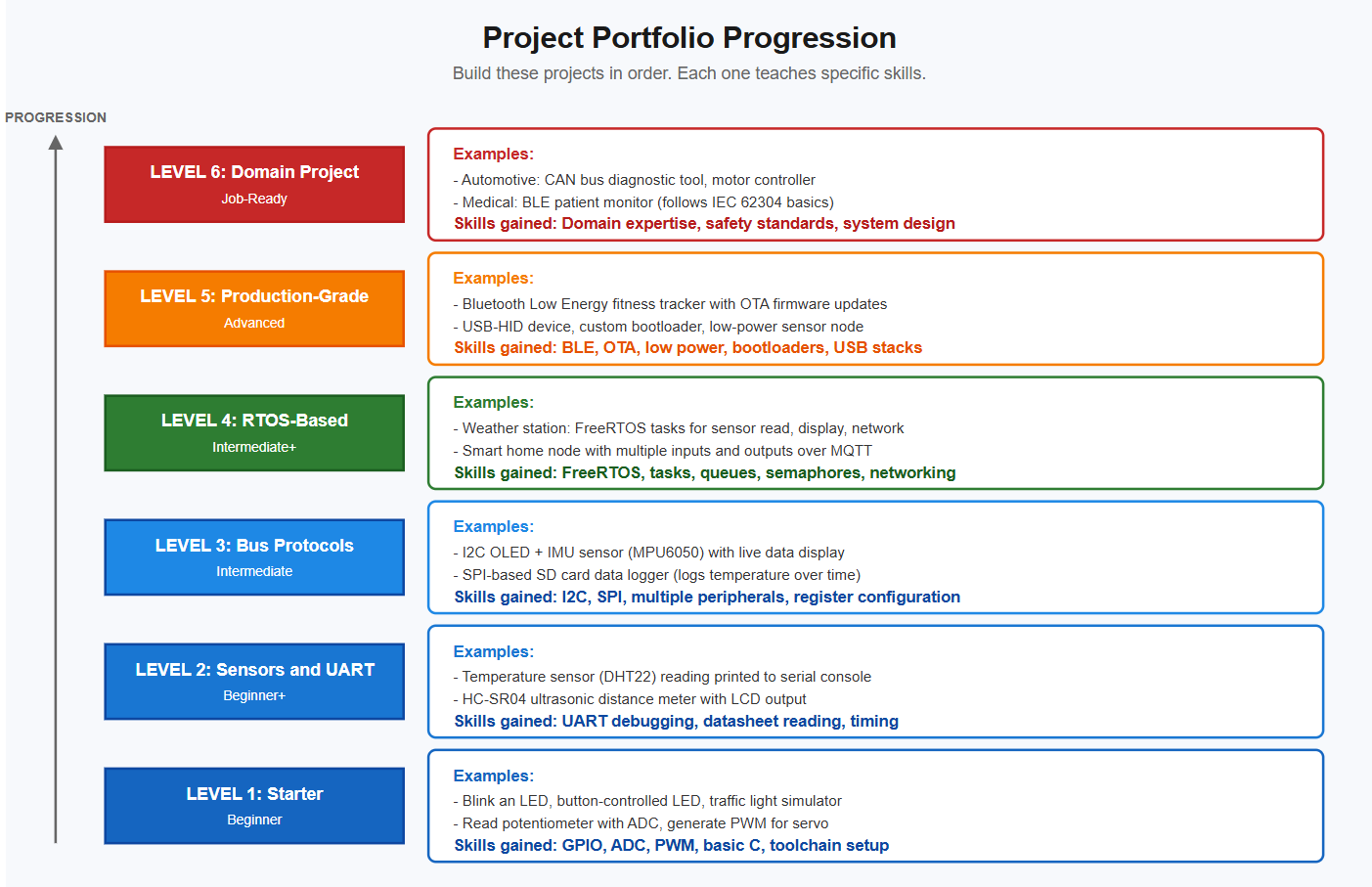
Build a portfolio:
This is what gets you interviews. Three or four substantial projects that show you can build real things.
Salary Expectations (Reality Check)
Salary depends heavily on country, company, and domain. Numbers below are approximate ranges based on current public data; verify with sites like Glassdoor or Levels.fyi for your specific region.
-
Junior firmware engineer (0-2 years) — Lower-tier markets ₹3-8 lakh INR/year; US $70-115k USD/year
-
Mid-level (2-5 years) — ₹8-20 lakh INR/year; US $100-150k USD/year
-
Senior (5-10 years) — ₹20-50+ lakh INR/year; US $130-180k USD/year
Domain matters. Automotive and medical pay more because of certification overhead. Consumer IoT often pays less but moves faster.
Conclusion
Becoming an embedded firmware engineer is not fast. It is not easy. But it is achievable for anyone willing to put in 18 to 24 months of focused learning and building.
The path is clear:
-
Master C
-
Pick one microcontroller and learn it deeply
-
Learn the four communication protocols
-
Learn an RTOS
-
Master the tools and engineering practices
-
Specialize in a domain and build a portfolio